
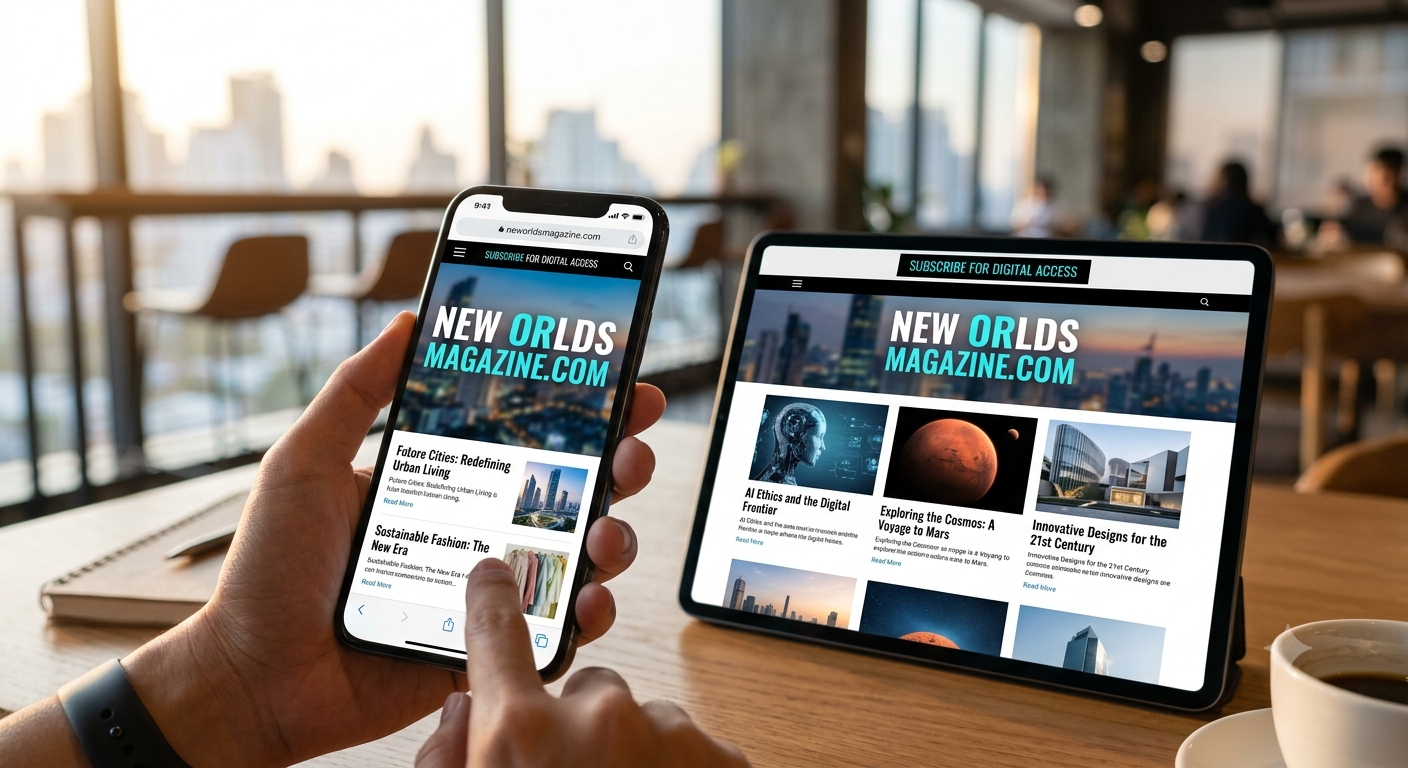
Neworldsmagazine.com is a broad online publication covering subjects that range from business and technology to entertainment, fashion, lifestyle, health, law and general-interest guides. Its appeal is easy to understand: the website publishes accessible articles on highly specific questions, trending names, practical decisions and everyday problems.
That breadth is also the reason readers should approach the platform thoughtfully. A useful article about clothing, careers or home improvement does not require the same evidence standard as content discussing medicine, law, finance or laboratory science.
The smartest way to use the website is not to ask whether every page is good or bad. Instead, evaluate each article according to its topic, sourcing, authorship and purpose.
What Is Neworldsmagazine.com?
The website describes itself as a meeting point for history, culture and modern storytelling. Its About page says its mission is to connect the past, present and future through historical features, cultural analysis, interviews and stories about human development.
The live publication, however, is considerably broader than that description. Its main navigation highlights Business, Entertainment, Fashion, Lifestyle, News and Technology, while the homepage also displays newer sections such as Health and Law.
Recent posts cover career guidance, laboratory procedures, consumer technology, skincare, legal topics, remote work and private-event planning.
This makes neworldsmagazine.com less like a narrowly focused historical journal and more like a general-interest digital magazine built around searchable, question-led content. Many readers will likely arrive through a search engine for one specific query rather than by visiting the homepage every day.
What Topics Does Neworldsmagazine.com Cover?
Business and Career Guidance
The Business archive includes employment guides, storage advice, vehicle decisions, retirement-related content, paperwork tips and commercially focused articles. The category had dozens of archive pages visible when reviewed, indicating a substantial volume of published material rather than a small collection of occasional posts.
Some articles are practical and clearly structured. A guide to remote customer-service jobs in Texas, for example, discusses communication skills, digital literacy, self-management, job-search strategy and application preparation.
The same article links to an employer and other external career resources. This demonstrates how informational content and commercial or recruitment-oriented references can appear within a single page.
Readers researching employment opportunities should therefore distinguish between general career advice and claims made about a particular employer. Details such as salaries, benefits, location requirements and open positions should always be verified through the employer’s official channels.
Technology and Digital Tools
Technology coverage includes artificial intelligence, hardware prototyping, electric scooters, social-media tools, workflow systems, video advertising and online-store automation. The archive uses direct, search-friendly titles that answer specific user questions or compare tools.
This section may be most useful for introductory explanations and trend discovery. It can help readers understand terminology before they move on to more technical sources.
For purchasing decisions or software implementation, readers should still compare specifications with:
- Official product documentation
- Manufacturer websites
- Independent testing
- Security disclosures
- Recent customer feedback
- Primary research or technical standards
Technology changes quickly. A comparison that was accurate when published may become outdated after a software update, product revision or pricing change.
Entertainment, Celebrities and Culture
Entertainment content ranges from acting careers and live music to celebrity relationships, streaming, historical media moments and sports-viewing culture.
The site also publishes biography-style pages built around popular search questions such as a public figure’s age, height, spouse or career.
These pages can provide a quick overview, but personal details should be checked against direct interviews, official profiles or reputable reporting. Celebrity information changes, and low-quality websites frequently repeat unverified claims from one another.
Dates deserve particular attention. A page may include an age calculated for one year while remaining accessible for several years afterward.
Fashion, Lifestyle, Home and Consumer Topics
Neworldsmagazine.com publishes fashion explainers, skincare articles, smart-casual guidance, travel-related pieces and home-improvement content. The format is generally beginner-friendly, relying on short sections, descriptive headings and direct answers.
That accessibility is useful for inspiration. It should not be confused with independent product testing unless an article explains:
- Which products were tested
- Who performed the test
- How long testing lasted
- What comparison criteria were used
- Whether products were purchased or supplied
- Whether commercial relationships influenced the selection
A polished list of recommendations is not automatically a laboratory test, professional evaluation or independent consumer report.
Health, Science, Law and Financial Subjects
The highest level of caution is needed when an article touches health, clinical care, legal rights, investing or scientific procedures.
The homepage and category pages show content involving mental-health facilities, dental procedures, alcohol withdrawal, tinnitus, auto-accident law, antibiotics and laboratory immunohistochemistry.
One laboratory article offers detailed claims about goat serum, blocking concentrations and incubation conditions. However, the visible byline is blank, and the page contains a supplier link.
That does not automatically make the information incorrect. It does mean readers should verify the technical claims through peer-reviewed protocols, institutional guidelines, manufacturer documentation and experienced laboratory professionals.
The same principle applies to medical, legal and financial articles. General educational content should never replace advice based on an individual’s circumstances.
How Neworldsmagazine.com Organizes Its Content
The publication follows a familiar digital-magazine structure:
- Category archives organize articles by subject.
- Search-oriented headlines target precise questions and long-tail keywords.
- Publication dates and reading times help users judge freshness.
- Short paragraphs and subheadings make pages easier to scan.
- Internal links direct visitors toward related articles.
- External links may lead to sources, brands, employers, suppliers or services.
- FAQ sections target common follow-up questions.
From an SEO perspective, this structure is effective because it aligns pages with clear search intent. A person looking for a specific age, product comparison, career path or “what is” answer can quickly understand what the page promises.
The trade-off is topical consistency. A publication covering laboratory science, celebrity biographies, fashion, legal issues and consumer finance under one editorial umbrella must work much harder to demonstrate genuine subject-matter expertise in every category.
Is Neworldsmagazine.com Legit and Trustworthy?
There is not enough verified evidence to responsibly label the website fraudulent. It is an active publication with accessible content, a Contact page, an About page and a Privacy Policy.
The Contact page provides an email address and invites feedback, assistance requests and collaboration inquiries.
At the same time, legitimacy and editorial reliability are not identical.
A real, functioning website can still publish articles of uneven quality. Readers should examine several trust signals before relying on information from any broad digital publication.
Positive Trust Signals
Neworldsmagazine.com provides:
- A public About page describing its stated mission
- A Contact page with a general inquiry email
- Dated articles and visible category archives
- Named authors on some posts
- A recurring author byline identified as “Carlos”
- A Privacy Policy discussing cookies, comments, embedded media and data requests
These elements make the website more transparent than an anonymous collection of undated pages.
Dates are especially helpful for topics involving technology, prices, public figures or rapidly changing recommendations. A publication date allows readers to determine whether a page may need updating.
Areas Where Transparency Could Improve
The reviewed pages also reveal several weaknesses:
- Some articles display blank bylines, including pages discussing specialized subjects.
- The visible navigation does not prominently present an editorial policy, corrections policy, fact-checking standard or author-credentials directory.
- The Privacy Policy repeatedly includes the words “Suggested text,” indicating that portions retain generic WordPress template language rather than a fully customized policy.
- The contact email uses
rabbiitfirm.com, a different domain from the publication itself. - Some pages contain commercial outbound links without a clearly visible explanation of whether the relationship is editorial, affiliate, sponsored or paid.
None of these points alone proves that an article is false. Together, however, they reduce the amount of editorial context available to readers.
A third-party guest-post marketplace also advertises paid placement on the domain with a dofollow backlink. That listing is not an official statement from the publication, so it does not prove that every article is sponsored or that the website approved the marketplace’s claims.
It does give readers another reason to look carefully for sponsorship and link disclosures on individual pages.
An E-E-A-T Assessment of Neworldsmagazine.com
Google’s E-E-A-T concept is best used as a quality framework rather than a simple numerical score. It examines Experience, Expertise, Authoritativeness and Trustworthiness.
Here is how the publication appears when reviewed through that lens.
Experience
Some articles provide practical steps and realistic examples, which can make them feel experience-led. Yet first-hand testing, fieldwork, interviews and personal credentials are not consistently explained.
A stronger article would clearly state:
- Who performed the test or investigation
- What direct experience the author has
- How the conclusion was reached
- What limitations affected the analysis
- Whether experts were interviewed
- Whether products or services were independently evaluated
A writer saying that something is “best” is less persuasive than a writer explaining exactly how it was tested.
Expertise
Expertise appears uneven because the site covers many unrelated fields. A general writer may competently explain a lifestyle topic but should not automatically be treated as an authority on clinical care, legal disputes, investment products or laboratory methods.
For high-stakes pages, readers should look for:
- Relevant professional qualifications
- Links to primary research
- References to recognized institutions
- Medical or legal review notes
- Updated citations
- Clear distinctions between education and professional advice
An article about a medical condition should ideally identify the writer, reviewer and sources. An article about fashion inspiration may not require the same level of professional verification.
Authoritativeness
The website has built a sizeable collection of indexed content. It has also been described in a distributed press release as a publication focused on history, culture and modern storytelling.
That press release is promotional material supplied by a third party rather than independent editorial validation. Its host also includes a disclaimer regarding the accuracy and reliability of the submitted information.
True authority develops when credible organizations cite a publication for:
- Original reporting
- Expert interviews
- Exclusive documents
- Unique research
- Reliable data
- Professional analysis
- Investigative work
Publishing volume can create visibility, but volume alone does not establish authority.
Trustworthiness
Trust is the most important part of the framework. Neworldsmagazine.com could strengthen trust by adding detailed author profiles, source standards, correction procedures, ownership information and conflict-of-interest disclosures.
Sponsored, contributed and affiliate content should also be clearly identified wherever applicable.
Until those signals become clearer, readers should treat the website as a starting point for discovery, not an unquestionable final authority.
How to Evaluate Any Article Before Trusting It
Use the following process whenever a page could influence your health, finances, rights, education or purchasing decisions.
1. Check the Publication Date
Confirm that prices, ages, regulations, software features and recommendations remain current. Search engines can display older content even when circumstances have changed.
2. Inspect the Byline
Look for an author biography, professional qualifications and previous work covering the same subject.
A missing byline does not automatically invalidate a page, but it prevents readers from evaluating the writer’s expertise.
3. Follow the Evidence
Strong factual claims should lead to credible evidence such as:
- Government publications
- Official statistics
- Peer-reviewed research
- Court documents
- Professional associations
- Original interviews
- Direct company statements
Links to other general blogs may create the appearance of sourcing without providing strong verification.
4. Examine Outbound Links
Ask whether the page is primarily educating you or steering you toward one employer, seller, supplier, clinic or product.
Commercial links are not inherently bad. The relationship should simply be transparent.
5. Look for Disclosure Language
Sponsored, affiliate and contributed content should be clearly identified. Readers deserve to know whether money, free products or business relationships influenced publication.
6. Cross-Check High-Stakes Claims
Compare medical, legal, financial and scientific guidance with authoritative sources. Where necessary, speak with an appropriately qualified professional.
7. Separate Facts From Confident Wording
A polished, confident tone is not proof that a claim is accurate. Good formatting can improve readability, but it cannot replace evidence.
This evaluation method works not only for neworldsmagazine.com but for nearly every broad-content publication competing for search traffic.
Who Will Find Neworldsmagazine.com Useful?
The website is best suited to readers who want:
- A quick introduction to an unfamiliar topic
- Ideas for further research
- Beginner-friendly explanations
- Definitions of unfamiliar terms
- Coverage of niche search questions
- Practical checklists and general guidance
- A broad mix of culture, business, technology and lifestyle content
It is less suitable as a standalone source for diagnosis, treatment, legal strategy, investment decisions, academic citation or technical laboratory procedures.
In those situations, use the article to identify terminology and relevant questions. Then move to primary research, official documentation and expert sources.
Why the Website Appears for Long-Tail Searches
Neworldsmagazine.com frequently publishes pages around exact, narrow questions. This strategy can attract people searching for names, ages, comparisons, discounts, career options, product terms and “what is” queries.
The approach works because long-tail searches usually reveal strong intent. Someone asking a detailed question often wants an immediate and well-organized answer.
The website supports that intent through:
- Keyword-focused titles
- Descriptive headings
- FAQ sections
- Short paragraphs
- Direct definitions
- Topic-specific subheadings
- Internal linking
This is a strong content-discovery model, especially for questions that larger publications may overlook.
For readers, the key lesson is simple: search relevance is not the same as source authority. A page can match a query extremely well while still requiring independent verification.
Final Verdict: Use Neworldsmagazine.com as a Discovery Tool
Neworldsmagazine.com is an active, wide-ranging online magazine with a large mix of practical, cultural, commercial and trend-focused content. Its strengths are accessibility, topical variety, scannable formatting and coverage of narrow questions that larger publications may ignore.
Its main limitation is inconsistent editorial transparency across a very broad subject range. Missing bylines, limited credential information, generic privacy-policy wording and unclear commercial disclosures make article-by-article evaluation essential.
The best next step is practical. Read the page, inspect its author and external links, note the publication date and verify consequential claims through primary sources.
Used that way, neworldsmagazine.com can help readers discover useful topics, questions and vocabulary without replacing the expert evidence required for important decisions.
Frequently Asked Questions
What is neworldsmagazine.com?
Neworldsmagazine.com is a general-interest online publication. It presents itself as a platform for history, culture and modern storytelling, while its live content also covers business, entertainment, technology, fashion, lifestyle, health, law, careers and consumer subjects.
Is neworldsmagazine.com a reliable source?
Its reliability depends on the individual article. Some pages provide useful introductory guidance, but the website does not consistently display detailed author credentials, primary sourcing or expert-review information.
Readers should independently verify medical, legal, scientific and financial claims before making decisions based on them.
Who writes for neworldsmagazine.com?
Many visible posts use the byline “Carlos,” while some pages show no author name. The reviewed navigation did not provide a prominent author directory containing detailed biographies and professional credentials.
Readers may therefore need to assess expertise through the article’s sources, depth and supporting evidence.
Does neworldsmagazine.com publish sponsored or guest content?
The website’s Contact page invites collaboration, while a third-party marketplace advertises paid guest-post placement on the domain. The external listing is not definitive proof about the origin of every article.
Readers should look for disclosure labels and evaluate commercial links on an individual basis.
How should I use information from neworldsmagazine.com?
Use it to understand basic concepts, discover search terms and identify questions for deeper research. Check the author, date, evidence and purpose of each article.
Before acting on anything involving health, law, finance, personal safety or technical work, confirm the information through current primary sources and appropriately qualified professionals.
