
When Was the First Computer Ever Made?
The question “when was the first computer ever made” has a more complicated answer than most people expect. The idea of a computer did not begin with laptops, desktops, or smartphones. It started centuries ago with simple calculation tools and gradually developed into powerful machines capable of processing millions of instructions every second.
The first computer ever made depends on how we define the word “computer.” Some historians consider early mechanical calculators as the first computers, while others point to programmable machines or the first electronic computers as the true beginning of modern computing.
From ancient counting devices to artificial intelligence systems, the journey of computing represents one of humanity’s greatest technological transformations.
In this article, we will explore when the first computer ever made appeared, who created it, how computers evolved through different generations, and why these inventions changed the world forever.
Key Takeaways: The First Computer Ever Made
Before exploring the complete timeline, here are the most important points:
- The earliest known calculating device was the abacus, developed thousands of years ago.
- Charles Babbage’s Analytical Engine (designed in the 1830s) is often called the first mechanical computer because it introduced programmable computing concepts.
- The Zuse Z3, created in 1941, was one of the first fully automatic programmable digital computers.
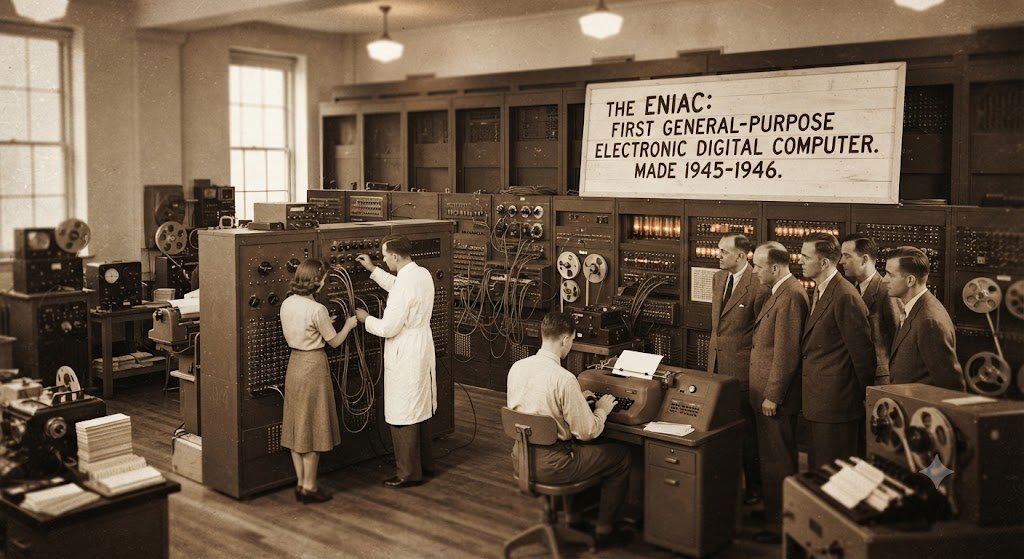
- ENIAC, completed in 1945, became one of the first large-scale electronic general-purpose computers.
- Modern computers evolved through several generations, from vacuum tubes to artificial intelligence-powered systems.
Understanding What Counts as the First Computer
The biggest challenge in answering when was the first computer ever made is understanding what qualifies as a computer.
A modern computer usually performs several functions:
- Accepts data through input
- Processes information using instructions
- Stores data
- Produces results through output
However, early inventions did not always include all these features. Some machines could only perform calculations, while others introduced programming concepts but were never fully built.
Because of this, historians usually divide the answer into different categories:
- First calculating device
- First mechanical computer
- First programmable computer
- First electronic computer
- First modern digital computer
Each category represents an important milestone in computer history.
The Earliest Computer-Like Device: The Abacus


Long before electronic machines existed, humans needed tools to solve mathematical problems faster. One of the earliest examples was the abacus, which appeared thousands of years ago.
The exact origin of the abacus is debated, but evidence suggests it was used in ancient civilizations such as Mesopotamia, China, Greece, and Rome.
The abacus consisted of:
- A frame
- Rods or grooves
- Movable beads used for counting
Although it was not programmable and could not store information like modern computers, it represented the beginning of human efforts to automate calculations.
The abacus remained useful for centuries and is still used today in some educational systems to teach mathematics.
The Mechanical Calculators Before Modern Computers
Before electronic computers existed, inventors created several mechanical devices that improved mathematical calculations.
These machines introduced important ideas that later influenced computer development.
Pascal’s Calculator (1642)
One of the earliest mechanical calculators was created by French mathematician and inventor Blaise Pascal.
Known as the Pascaline, this machine was designed to help with addition and subtraction.
It used:
- Rotating gears
- Mechanical wheels
- Number displays
Pascal developed the device to assist his father, who worked as a tax commissioner and needed help with calculations.
Although limited compared with later computers, the Pascaline showed that machines could perform mathematical operations automatically.
Leibniz’s Stepped Reckoner (1673)
German mathematician Gottfried Wilhelm Leibniz improved mechanical calculation technology by creating the Stepped Reckoner.
Unlike Pascal’s machine, Leibniz’s invention could perform:
- Addition
- Subtraction
- Multiplication
- Division
Leibniz also developed the binary number system, which later became the foundation of digital computing.
Modern computers process information using binary code, consisting of only two values:
- 0
- 1
This connection makes Leibniz’s work extremely important in the history of computing.
Charles Babbage: The Father of the Computer

When people ask when was the first computer ever made, many experts mention the work of Charles Babbage.
Babbage, an English mathematician and inventor, designed machines that introduced concepts similar to modern computers.
Because of his contributions, he is often called the Father of the Computer.
The Difference Engine (1822)
In 1822, Charles Babbage proposed the Difference Engine, a mechanical device designed to automatically calculate mathematical tables.
During the 19th century, mathematical tables were extremely important for:
- Navigation
- Astronomy
- Engineering
- Scientific research
However, manually calculated tables often contained errors.
Babbage wanted to create a machine that could produce accurate results automatically.
The Difference Engine included:
- Mechanical gears
- Number columns
- Automatic calculation functions
Although the complete machine was not finished during Babbage’s lifetime, the design represented a major step toward automated computing.
The Analytical Engine: The First Concept of a Programmable Computer
The most important answer to when was the first computer ever made often points to Babbage’s Analytical Engine.
Designed in the 1830s, the Analytical Engine was the first machine concept that contained the basic ideas of a modern programmable computer.
It included concepts such as:
- A processing unit (called the mill)
- Memory storage (called the store)
- Input through punched cards
- Programmable instructions
- Output mechanisms
These features closely resemble modern computer architecture.
Babbage never completed the full Analytical Engine because the technology and funding available at the time were insufficient.
However, the design was revolutionary.
Ada Lovelace: The First Computer Programmer
The story of early computers cannot be completed without mentioning Ada Lovelace.
While working with Charles Babbage, Lovelace wrote detailed notes about the Analytical Engine and created an algorithm designed for the machine.
Because of this work, she is widely recognized as the world’s first computer programmer.
Her ideas went beyond simple calculations. She understood that computers could potentially manipulate symbols, create music, and perform tasks beyond mathematics.
This vision was far ahead of her time.
The development of computers accelerated during the 20th century when engineers began creating machines that could follow programmed instructions automatically.
While Charles Babbage’s Analytical Engine introduced the concept of programmable computing, practical computers required advances in electronics, electricity, and engineering.
The answer to when was the first computer ever made changes depending on whether we focus on ideas, working machines, or electronic technology.
The early 1900s produced several important breakthroughs that transformed computing from mechanical calculation into automatic information processing.
The Zuse Z3: One of the First Fully Automatic Programmable Computers


In 1941, German engineer Konrad Zuse created the Zuse Z3, a machine considered by many historians as one of the first fully automatic programmable digital computers.
The Z3 was a major milestone because it could:
- Perform calculations automatically
- Execute stored programs
- Use binary numbers
- Process instructions without manual adjustment
The machine was built using approximately 2,600 electrical relays instead of modern electronic components.
Although the Z3 was destroyed during World War II, its design proved that programmable digital computing was possible.
Many researchers consider the Z3 a strong candidate when discussing the first computer ever made because it was a working programmable computer rather than only a theoretical design.
The Colossus: The First Electronic Programmable Computer
During World War II, computers were developed for military purposes.
One of the most important machines was Colossus, created in Britain in 1943.
Colossus was designed to help decode encrypted German military messages.
It used:
- Vacuum tubes
- Electronic circuits
- Binary processing
- Programmable settings
Unlike earlier mechanical computers, Colossus used electronics to perform calculations much faster.
However, Colossus was a special-purpose machine. It was designed specifically for codebreaking rather than general computing.
Because of this, historians debate whether it should be considered the first true computer.
ENIAC: The First Large-Scale General-Purpose Electronic Computer


When discussing when was the first computer ever made, one of the most common answers is ENIAC.
The Electronic Numerical Integrator and Computer (ENIAC) was completed in 1945 and publicly introduced in 1946 at the University of Pennsylvania.
ENIAC was revolutionary because it was:
- Fully electronic
- General-purpose
- Programmable
- Much faster than mechanical machines
The computer occupied a huge room and contained:
- Around 18,000 vacuum tubes
- Thousands of electrical components
- Massive wiring systems
Compared with modern computers, ENIAC was extremely limited, but at the time it represented a technological breakthrough.
A calculation that once required hours of human work could be completed in seconds.
Why ENIAC Changed Computer History
ENIAC demonstrated that electronic computing was practical.
Before ENIAC, computers depended mainly on mechanical parts or electromechanical relays.
Electronic components allowed computers to:
- Process information faster
- Handle more complex calculations
- Support scientific research
- Assist military and engineering projects
ENIAC influenced future computer designs and helped begin the modern computer era.
The First Stored-Program Computers
One of the biggest challenges in early computing was programming.
Early machines often required engineers to physically change wiring or switches to modify instructions.
The next major breakthrough was the concept of stored-program computing.
A stored-program computer keeps instructions and data inside memory, allowing the machine to change tasks through software.
Important early stored-program computers included:
Manchester Baby (1948)
The Manchester Small-Scale Experimental Machine, commonly called the Manchester Baby, was the first computer to successfully run a stored program.
Developed in the United Kingdom, it demonstrated a completely new approach to computing.
Its importance came from proving that:
- Programs could be stored electronically
- Computers could modify tasks through software
- Memory-based computing was possible
EDSAC (1949)
The Electronic Delay Storage Automatic Calculator (EDSAC) was another important early computer.
Created at the University of Cambridge, EDSAC became one of the first practical stored-program computers.
It introduced ideas that influenced future software development.
The Evolution of Computers Through Generations
Understanding when was the first computer ever made requires looking at how computers developed after the first machines.
Computer history is commonly divided into five generations.
First Generation Computers (1940s–1950s): Vacuum Tube Machines
The earliest electronic computers used vacuum tubes.
Examples included:
- ENIAC
- UNIVAC
- EDSAC
Characteristics:
- Extremely large size
- High electricity consumption
- Produced significant heat
- Limited memory
- Machine-level programming
Despite their limitations, these computers established the foundation of modern computing.
Second Generation Computers (1950s–1960s): The Rise of Transistors
Transistors replaced vacuum tubes because they were:
- Smaller
- More reliable
- Faster
- More energy efficient
This generation introduced:
- Better programming languages
- Improved storage systems
- Commercial computer systems
Companies began producing computers for businesses, universities, and government organizations.
Third Generation Computers (1960s–1970s): Integrated Circuits
Integrated circuits allowed multiple electronic components to be placed onto a single chip.
This development dramatically reduced computer size.
Third-generation computers introduced:
- Operating systems
- Keyboard and monitor interaction
- More advanced software
Computers became more accessible outside government and scientific institutions.
Fourth Generation Computers (1970s–Present): Microprocessors
The invention of the microprocessor changed everything.
A complete central processing unit could now fit onto a single chip.
This led to:
- Personal computers
- Laptops
- Smartphones
- Consumer electronics
Companies such as Intel and others helped drive the microprocessor revolution.
The personal computer era began, bringing computing power into homes and workplaces.
Fifth Generation Computers: Artificial Intelligence and Beyond
Today’s computers represent a new stage focused on artificial intelligence and advanced computing.
Modern systems use:
- Machine learning
- Neural networks
- Cloud computing
- Quantum research
- Natural language processing
Computers are no longer only calculation machines. They can recognize images, understand language, generate content, and assist humans in complex decision-making.
How the First Computer Ever Made Influenced Modern Technology
The inventions behind early computers created the foundation for nearly every modern technology.
Today’s devices depend on concepts developed by early computer pioneers.
Examples include:
Smartphones
Modern smartphones contain processors far more powerful than early computers like ENIAC.
They combine:
- Computing power
- Internet connectivity
- Artificial intelligence
- Digital communication
Artificial Intelligence
AI systems rely on:
- Algorithms
- Data processing
- Memory systems
- Mathematical models
These ideas trace back to the earliest developments in computer science.
Internet Technology
The internet depends on computers communicating with each other.
Without the evolution from early machines to modern processors, global digital communication would not exist.
Common Misunderstandings About the First Computer
Many people assume there is one simple answer to when was the first computer ever made, but computer history is more complex.
Here are some common misconceptions:
“The first computer was invented in the 1940s”
Not exactly.
The 1940s produced the first electronic computers, but earlier mechanical computer concepts existed during the 1800s.
“Charles Babbage built the first computer”
Babbage designed the first programmable computer concept, but his complete Analytical Engine was never finished during his lifetime.
“ENIAC was the first computer”
ENIAC was one of the first large-scale electronic general-purpose computers, but other important machines existed before and around the same period.
Frequently Asked Questions (FAQ)
1. When was the first computer ever made?
The answer depends on the definition of a computer. The earliest calculating devices appeared thousands of years ago, while the first programmable mechanical computer concept was designed by Charles Babbage in the 1830s. The first electronic computers appeared during the 1940s.
2. Who invented the first computer?
No single person invented the first computer. Many inventors contributed to computer development. Charles Babbage created the concept of a programmable mechanical computer, while engineers like Konrad Zuse and teams behind ENIAC developed early working electronic computers.
3. Was the abacus the first computer?
The abacus is considered one of the earliest calculating tools, but it was not a computer in the modern sense because it could not store programs or automatically execute instructions.
4. What was the first modern computer?
Many historians consider ENIAC one of the first modern computers because it was electronic, programmable, and designed for general-purpose calculations.
5. How have computers changed since the first computer ever made?
Computers have transformed from massive machines filling entire rooms into portable devices that fit in pockets. Modern computers are faster, smaller, connected globally, and capable of artificial intelligence applications.
Conclusion: The Journey From the First Computer to Modern Technology
The story of when was the first computer ever made is not about one single machine. It is a long journey that began with simple counting tools and evolved through mechanical calculators, programmable designs, electronic computers, and artificial intelligence systems.
The first computer pioneers created ideas that continue to influence technology today.
Charles Babbage introduced programmable computing concepts. Konrad Zuse proved automatic digital computing was possible. ENIAC demonstrated the power of electronic machines.
Understanding this history helps us appreciate how far technology has advanced and where computing may go next.
If you want to explore modern technology, start by learning the basics of computer hardware, programming, artificial intelligence, and digital systems. The machines we use today are built on centuries of innovation that started with the earliest attempts to make calculations easier.
