
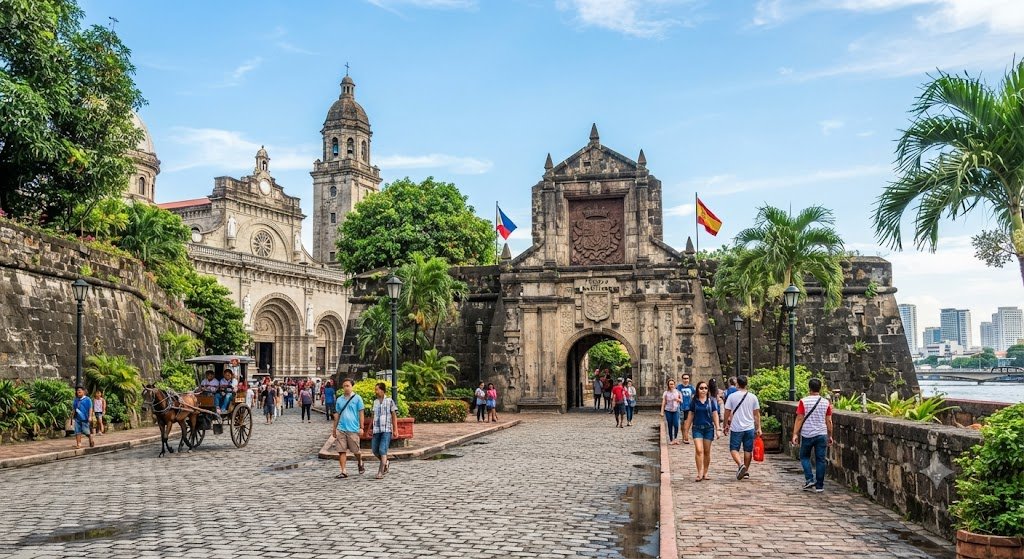
The historical places in Manila Philippines tell the story of more than four centuries of colonial rule, revolution, resilience, and independence. Every cobblestone street, centuries-old church, fortress, museum, and monument preserves a chapter of Philippine history that continues to shape the nation’s identity.
Whether you’re a first-time visitor, a history enthusiast, or simply curious about Filipino culture, exploring the historical places in Manila Philippines offers an unforgettable journey through Spanish, American, Japanese, and modern Filipino influences. From the iconic walls of Intramuros to Rizal Park’s symbolic monuments, Manila combines architectural beauty with compelling historical narratives.
This comprehensive guide explores the city’s most important landmarks, explains why they matter, provides travel tips, and highlights hidden gems that many tourists overlook.
Why Manila Is One of Southeast Asia’s Greatest Historical Cities
Long before modern skyscrapers dominated the skyline, Manila served as one of Asia’s busiest trading ports. Its strategic location connected merchants from China, Japan, India, Mexico, and Spain.
Several factors make Manila historically significant:
- Capital of the Philippines since the Spanish colonial period
- Center of Spanish administration for over 300 years
- Home to important revolutionary movements
- Witness to World War II destruction
- Birthplace of many national heroes
- Center of Philippine politics, religion, and education
The historical places in Manila Philippines showcase every era of this remarkable evolution.
Intramuros: The Historic Walled City
No discussion about historical places in Manila Philippines is complete without Intramuros.
Known as the “Walled City,” Intramuros was built by the Spanish in 1571 to protect their colonial government. Massive stone walls, fortified gates, watchtowers, and churches still stand despite earthquakes, wars, and reconstruction.
Highlights Inside Intramuros
- Ancient stone walls
- Colonial streets
- Horse-drawn carriage rides (Kalesa)
- Museums
- Historic churches
- Government buildings
- Spanish-era architecture
Walking through Intramuros feels like stepping into another century.
Fort Santiago: Manila’s Most Famous Fortress
Fort Santiago remains among the most visited historical places in Manila Philippines.
Originally constructed by Spanish conquistador Miguel López de Legazpi, the fortress guarded Manila against foreign invasions.
Historical Importance
Fort Santiago served many purposes:
- Military headquarters
- Defense fortress
- Prison
- Administrative center
It became especially significant because Dr. José Rizal, the Philippine national hero, spent his final days imprisoned here before his execution in 1896.
Visitors today can explore:
- Rizal Shrine Museum
- Underground dungeons
- Old barracks
- Stone gates
- Gardens
- Historical exhibits
San Agustin Church: A UNESCO World Heritage Site
San Agustin Church is the oldest surviving stone church in the Philippines.
Completed in 1607, it has survived:
- Multiple earthquakes
- Fires
- World War II bombing
- Political upheavals
Its stunning Baroque architecture, ornate ceilings, carved wooden doors, and religious artifacts make it one of the finest historical places in Manila Philippines.
What Makes It Special
UNESCO World Heritage Status
Its inclusion among the Baroque Churches of the Philippines recognizes its exceptional architectural and cultural significance.
Manila Cathedral: Symbol of Faith and Resilience
Located inside Intramuros, the Manila Cathedral has been rebuilt numerous times due to earthquakes and war damage.
Today’s cathedral combines:
- Romanesque Revival architecture
- Beautiful stained glass
- Bronze doors
- Massive pipe organ
- Elegant interior
It remains the spiritual center of the Roman Catholic Archdiocese of Manila.
Rizal Park (Luneta Park)
Few historical places in Manila Philippines hold as much emotional significance as Rizal Park.
This sprawling urban park honors Dr. José Rizal, whose writings inspired the Philippine Revolution.
Attractions Within Rizal Park
| Attraction | Historical Significance |
|---|---|
| Rizal Monument | National hero memorial |
| Kilometer Zero | Starting point of Philippine roads |
| Independence Flagpole | Symbol of national sovereignty |
| Chinese Garden | Cultural heritage |
| Japanese Garden | International friendship |
| Orchidarium | Botanical collection |
The daily flag ceremony continues to attract both locals and tourists.
National Museum Complex
History lovers should dedicate several hours to the National Museum Complex.
It consists of multiple museums covering:
- Fine Arts
- Anthropology
- Natural History
Must-See Exhibits
- Spoliarium by Juan Luna
- Archaeological artifacts
- Ancient pottery
- Indigenous textiles
- Gold collections
- Marine biodiversity displays
These museums provide valuable context for understanding the historical places in Manila Philippines.
Casa Manila
Casa Manila recreates the lifestyle of wealthy Filipino families during the Spanish colonial period.
Visitors can see:
- Antique furniture
- Crystal chandeliers
- Colonial kitchens
- Spanish bedrooms
- Elegant courtyards
- Original artwork
Everything is arranged to resemble an authentic 19th-century mansion.
Palacio del Gobernador
Once serving as the residence of Spanish governors-general, this building symbolizes colonial governance.
Although reconstructed after World War II, it preserves historical significance through its location and surrounding heritage structures.
Plaza Roma
Plaza Roma served as the political heart of Spanish Manila.
Important government buildings surround the square, including:
- Manila Cathedral
- Palacio del Gobernador
- Ayuntamiento
Today, it remains one of the most photographed historical places in Manila Philippines.
Ayuntamiento de Manila
Originally functioning as Manila’s city hall during Spanish rule, the Ayuntamiento played an important administrative role.
Its restored architecture reflects colonial elegance while housing government institutions today.
Bahay Tsinoy Museum
Philippine history cannot be understood without acknowledging the Chinese community’s contributions.
The Bahay Tsinoy Museum explores:
- Chinese migration
- Commerce
- Cultural exchange
- Family life
- Entrepreneurship
Interactive exhibits make history engaging for visitors of all ages.
Binondo: The World’s Oldest Chinatown
Established in 1594, Binondo is recognized as the world’s oldest Chinatown.
Beyond incredible food, visitors discover:
- Historic temples
- Colonial-era buildings
- Traditional pharmacies
- Old business districts
- Heritage bridges
Walking through Binondo reveals centuries of multicultural influence.
Quiapo Church
The Minor Basilica of the Black Nazarene draws millions of pilgrims annually.
Its annual procession ranks among Asia’s largest religious gatherings.
The church combines spiritual importance with architectural heritage, making it one of the essential historical places in Manila Philippines.
Malacañang Palace
As the official residence of Philippine presidents, Malacañang Palace has witnessed many defining moments in national history.
While public access is limited, the nearby museum provides insight into:
- Presidential history
- Political events
- National governance
- Historic artifacts
Paco Park
Originally built as a cemetery during Spanish rule, Paco Park later became a peaceful public garden.
It is remembered for:
- Circular stone walls
- Historic chapel
- Landscaped gardens
- Cultural performances
- Quiet atmosphere
José Rizal’s remains were temporarily interred here before being transferred to Rizal Park.
Jones Bridge
Jones Bridge connects Manila’s historic and modern districts.
Its elegant neoclassical design features:
- Decorative lamp posts
- Sculptures
- River views
- Heritage architecture
The bridge is particularly beautiful after sunset.
Metropolitan Theater
The Metropolitan Theater showcases the Philippines’ Art Deco heritage.
Following extensive restoration, it now hosts:
- Performances
- Cultural events
- Concerts
- Art exhibitions
Its colorful façade makes it one of Manila’s architectural treasures.
Arroceros Forest Park
Often called Manila’s “Last Lung,” Arroceros Forest Park combines environmental conservation with historical significance.
The surrounding district played important roles throughout Manila’s urban development.
Hidden Historical Gems Worth Visiting
Many visitors focus only on Intramuros, but several lesser-known attractions deserve attention.
Museo de Intramuros
This museum houses religious art and ecclesiastical artifacts from various regions of the Philippines.
Plaza San Luis
A reconstructed colonial plaza showcasing traditional Filipino-Spanish architecture.
Baluarte de San Diego
One of the oldest surviving fortifications in Intramuros, featuring gardens and panoramic views.
Aduana Building
Once the customs headquarters during Spanish rule, it played a vital role in Manila’s international trade.
Best Time to Explore Historical Places in Manila Philippines
Weather significantly affects sightseeing.
| Season | Experience |
|---|---|
| November–February | Coolest weather, ideal for walking |
| March–May | Hot but generally dry |
| June–October | Rainy season with occasional storms |
Morning visits are usually the most comfortable.
Suggested One-Day Historical Walking Itinerary
If time is limited, follow this route:
- Start at Fort Santiago
- Walk through Intramuros
- Visit San Agustin Church
- Explore Casa Manila
- Stop at Manila Cathedral
- Continue to Plaza Roma
- Visit the National Museum
- End the day at Rizal Park
This itinerary covers many of the finest historical places in Manila Philippines within a manageable distance.
Travel Tips for First-Time Visitors
Planning ahead makes the experience more enjoyable.
Helpful tips include:
- Wear comfortable walking shoes.
- Carry water during warm months.
- Bring cash for small vendors.
- Visit museums on weekdays for smaller crowds.
- Hire a licensed guide for deeper historical insights.
- Respect church dress codes.
- Allocate enough time for Intramuros alone.
Why These Historical Sites Matter Today
The historical places in Manila Philippines are more than tourist attractions.
They preserve collective memory.
They remind Filipinos of colonial struggles, revolutionary courage, cultural diversity, and national resilience. Every restored church, museum, monument, and fortress helps future generations understand how the Philippines evolved into the nation it is today.
Heritage conservation efforts continue because these landmarks are irreplaceable educational resources as well as symbols of national pride.
Conclusion
Exploring the historical places in Manila Philippines is one of the best ways to understand the country’s remarkable past. From the fortified walls of Intramuros and the solemn grounds of Fort Santiago to the magnificent San Agustin Church and the inspiring Rizal Park, every destination offers a meaningful glimpse into Philippine history.
If you’re planning a trip, set aside at least one full day—or ideally several—to experience these landmarks at a relaxed pace. Take guided tours, visit the museums, talk with local guides, and appreciate the stories behind every monument. The richer your understanding, the more rewarding your visit to Manila will become.
Frequently Asked Questions
What is the most famous historical place in Manila Philippines?
Intramuros is widely regarded as the most famous historical site. Its preserved Spanish colonial architecture, ancient walls, churches, museums, and Fort Santiago make it the city’s premier heritage destination.
Why is Fort Santiago important in Philippine history?
Fort Santiago served as a military fortress and prison during the Spanish colonial period. It is especially significant because Philippine national hero Dr. José Rizal was imprisoned there before his execution in 1896.
Which historical place in Manila is a UNESCO World Heritage Site?
San Agustin Church is part of the UNESCO-listed Baroque Churches of the Philippines. Completed in 1607, it is the oldest surviving stone church in the country.
Can you explore Manila’s historical sites in one day?
Yes, many major landmarks—including Intramuros, Fort Santiago, Manila Cathedral, San Agustin Church, Casa Manila, the National Museum, and Rizal Park—can be visited in one well-planned day, although spending two days allows for a more relaxed experience.
What is the best month to visit historical places in Manila Philippines?
The most comfortable months are November through February, when temperatures are cooler and humidity is lower, making walking tours of Manila’s historic districts much more enjoyable.
