
When readers search for theconversation.com credibility, they are usually trying to answer a simple but important question: Can The Conversation be trusted as a reliable source of information? In a digital environment filled with misinformation, opinion-driven articles, and low-quality content, understanding how a publication creates and verifies its articles has become essential.
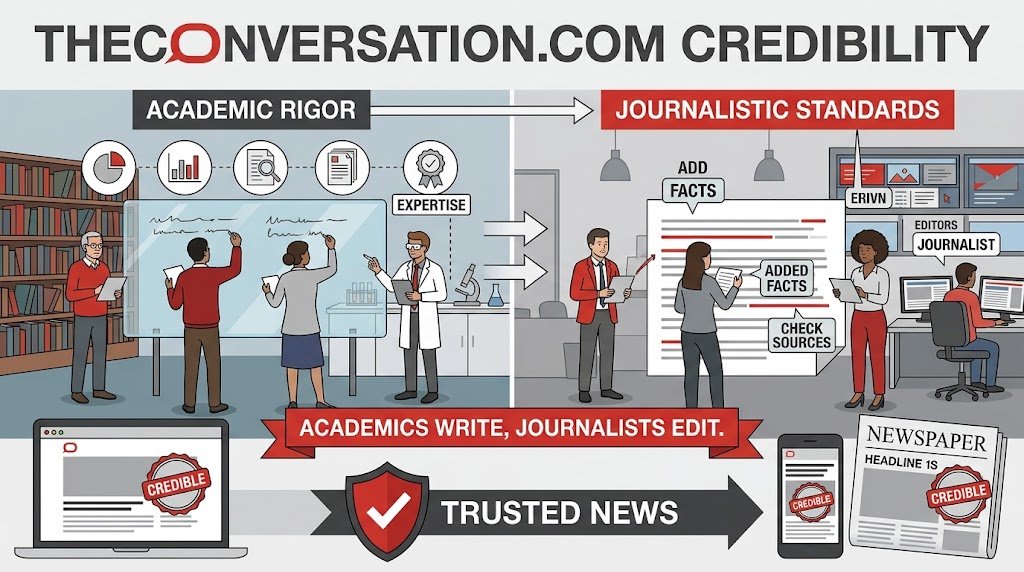
The Conversation follows a different model from traditional news websites. Instead of relying mainly on newsroom reporters, it publishes articles written by academics, researchers, and subject-matter experts, with professional editors helping transform complex research into accessible explanations.
However, credibility is not only about who writes an article. It also depends on editorial transparency, sourcing practices, fact-checking systems, funding structure, and how readers interpret expert commentary.
This detailed guide examines theconversation.com credibility from multiple angles, including its publishing model, academic involvement, editorial process, potential limitations, and how readers should use the platform responsibly.
What Is The Conversation and Why Does Its Credibility Matter?
The Conversation is a nonprofit media platform that publishes analysis and explanations from researchers and academics. Its goal is to bring expert knowledge from universities and research institutions to the general public.
Unlike many news organizations where journalists conduct interviews and write reports, The Conversation often begins with the researcher themselves. An academic writes about their area of expertise, and professional editors help make the information understandable for everyday readers.
This approach creates a unique publishing model:
- Experts provide subject knowledge
- Editors improve clarity and structure
- Research evidence supports claims
- Readers gain access to academic perspectives
The question of theconversation.com credibility matters because readers increasingly need to separate trustworthy expert analysis from content created primarily for clicks, advertising revenue, or political influence.
A website can look professional and still lack strong verification systems. That is why examining the behind-the-scenes process is more valuable than judging only by appearance.
How Does TheConversation.com Credibility Compare With Traditional News Sources?
The credibility of The Conversation comes from a hybrid model that combines academic expertise with journalism practices.
Traditional news organizations usually have:
- Reporters
- Editors
- Investigative teams
- News desks
- Editorial policies
The Conversation adds another layer:
- University researchers
- Scientists
- Professors
- Subject specialists
This means many articles are written by people who have spent years studying a specific topic.
For example, an article about climate science may come from a climate researcher, while a piece about economics may be written by an economist. This can provide deeper technical knowledge than a general news report.
However, expertise in one field does not automatically guarantee that every interpretation is perfect. Academic authors may still have their own research perspectives, assumptions, or areas of focus.
A responsible reader should consider:
- Who wrote the article?
- What are their qualifications?
- Are sources provided?
- Is the article explaining research or promoting an argument?
Why Expert Authors Increase TheConversation.com Credibility
Academic Expertise and First-Hand Knowledge
One of the strongest factors behind theconversation.com credibility is its reliance on expert contributors.
Many contributors are:
- University professors
- Researchers
- Scientists
- Policy specialists
- Industry experts
This aligns with Google’s E-E-A-T principles:
Experience: Authors often have direct involvement in research.
Expertise: Contributors usually write within their professional field.
Authoritativeness: Academic affiliations provide additional context.
Trustworthiness: Disclosures, citations, and editorial oversight improve transparency.
When readers see a qualified expert explaining a complicated issue, they receive information closer to the original research process.
Articles Usually Include Research-Based Context
A major strength of The Conversation is its focus on explaining the “why” behind events.
Many online articles summarize headlines:
“A new study found X.”
The Conversation often attempts to answer:
- Why did researchers reach this conclusion?
- What methods were used?
- What limitations exist?
- How does this affect society?
This explanatory approach is especially valuable for topics such as:
- Science
- Healthcare
- Technology
- Education
- Environmental issues
- Economics
Research communication requires context. Without context, even accurate facts can be misunderstood.
The Editorial Process Behind TheConversation.com Credibility
Professional Editors Review Articles
Although academics write many articles, they are not simply uploaded without review.
The Conversation uses professional editors who work with contributors to improve:
- Accuracy
- Readability
- Structure
- Public understanding
The publication states that it operates with editorial guidelines covering independence, authorship, conflicts of interest, and editing standards.
Editors help bridge the gap between academic writing and public communication.
A scientific paper may contain technical language that only specialists understand. An edited article explains those concepts in a way that broader audiences can follow.
Conflict of Interest Disclosures
Transparency plays an important role in evaluating media credibility.
The Conversation requires contributors to disclose relevant affiliations and potential conflicts of interest.
For example, readers should know if:
- A researcher received funding from an organization connected to the topic
- An author is discussing their own published study
- A contributor has professional involvement with a company or institution
Disclosure does not automatically make information unreliable. Instead, it allows readers to evaluate context.
Does The Conversation Fact-Check Its Articles?
Fact-checking is one of the most important parts of theconversation.com credibility.
The platform has a dedicated fact-checking approach for certain content, including fact-check articles that undergo additional review processes.
Fact-checking helps identify:
- Incorrect claims
- Misleading statements
- Unsupported information
- Errors in interpretation
However, readers should understand an important distinction:
Fact-checking does not mean every opinion or interpretation becomes objectively perfect.
Academic articles often involve analysis. Two qualified researchers may interpret evidence differently.
Credibility comes from transparency about evidence, methods, and limitations.
Is TheConversation.com Biased?
A common question connected to theconversation.com credibility is whether the platform has a political or ideological bias.
Independent media-rating organizations have assessed The Conversation as having generally strong factual reporting and relatively low bias. Media Bias/Fact Check, for example, rates it as “Least Biased” and “Very High” for factual reporting.
However, bias evaluation is complicated.
Every publication makes choices about:
- Which topics receive attention
- Which experts are published
- How stories are framed
The Conversation’s model is primarily academic explanation rather than traditional opinion journalism.
Readers should still:
- Check multiple perspectives
- Review original research when possible
- Understand the difference between evidence and interpretation
Potential Limitations of TheConversation.com Credibility
No information source is perfect.
While The Conversation has several credibility strengths, readers should consider some limitations.
Academic Perspective May Not Represent Every View
Researchers typically write from their area of expertise.
That is valuable, but a single expert perspective may not represent all debates surrounding a topic.
For controversial issues, readers may benefit from reviewing:
- Multiple academic viewpoints
- Original studies
- Government reports
- Independent research
Articles Are Explanations, Not Always Breaking News Reports
The Conversation is not designed primarily as a fast-breaking news outlet.
Its strength is:
- Analysis
- Explanation
- Research interpretation
Readers looking for immediate event updates may need traditional news sources alongside it.
How To Evaluate TheConversation.com Credibility Yourself
Before trusting any article, use this checklist:
1. Check the Author
Look for:
- Academic position
- Research background
- Institutional affiliation
2. Review Sources
Reliable articles usually provide:
- Research links
- Academic references
- Supporting evidence
3. Separate Facts From Opinions
Ask:
- Is this a documented finding?
- Is this the author’s interpretation?
- Are alternative views discussed?
4. Look at Publication Date
Research can change quickly, especially in:
- Medicine
- Technology
- Climate science
FAQ About TheConversation.com Credibility
Is The Conversation a trustworthy website?
Yes, The Conversation is generally considered a credible source because it combines academic authorship with professional editorial review and transparency practices.
Who writes articles on The Conversation?
Articles are primarily written by academics, researchers, and subject specialists who contribute expert analysis in their fields.
Is The Conversation peer reviewed?
The Conversation is not a peer-reviewed journal. However, some fact-checking content involves additional review procedures, and articles receive editorial oversight.
Can students use The Conversation as a reliable source?
Students can use The Conversation for background research and understanding complex topics. For academic assignments, they should also consult original studies and scholarly publications when required.
Is The Conversation better than regular news websites?
It depends on the purpose. The Conversation is especially useful for expert explanations and research-based analysis, while traditional news organizations may be stronger for breaking events and investigative reporting.
Final Verdict: Understanding TheConversation.com Credibility
When evaluating theconversation.com credibility, the strongest evidence comes from its publishing structure: expert authors, professional editors, transparency policies, and research-focused reporting.
The platform is especially valuable for readers who want deeper explanations instead of short summaries. It helps translate academic knowledge into accessible language without requiring readers to navigate complex journal papers.
Still, smart information consumption requires more than trusting any single website. Check authors, review evidence, compare perspectives, and follow sources back to original research whenever possible.
Used correctly, The Conversation can be a valuable tool for learning, research, and understanding complex issues through expert perspectives.
