
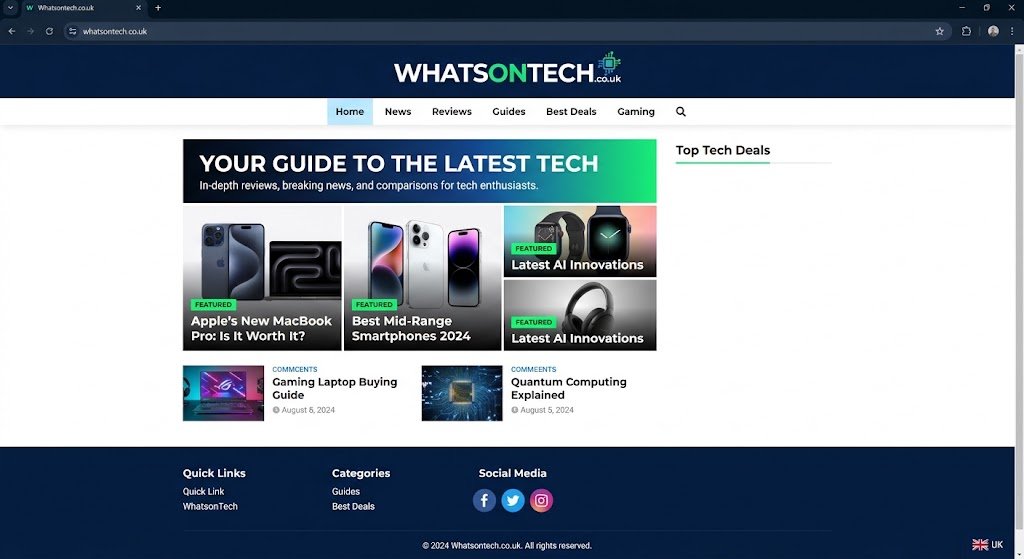
Whatsontech.co.uk is a technology-focused online publication covering digital innovation, software, artificial intelligence, consumer electronics, business technology, and practical technology guides. Its broad editorial approach makes it relevant to readers who want to understand technological developments without having to navigate complicated technical documentation.
Technology news is everywhere, but useful explanations are harder to find. A new AI tool might promise to transform productivity, a software update could change how a business operates, and a security vulnerability might require immediate attention.
The real challenge is knowing which developments matter and which claims deserve closer examination.
That is where technology publications can play an important role. Rather than concentrating exclusively on hardware launches or breaking industry announcements, WhatsOnTech covers a mixture of practical applications, emerging technologies, and broader digital trends.
This guide examines the website’s background, editorial scope, content categories, credibility indicators, strengths, limitations, and practical value. It also explains how readers can evaluate technology articles more effectively and use them to make informed decisions.
What Is Whatsontech.co.uk?
Whatsontech.co.uk is an online technology blog that publishes articles about developments in the digital world. Its stated mission is to explain how technology influences everyday activities, industries, and the way people interact with modern products and services.
According to its official About page, the publication traces its beginnings to 2014, when four technology enthusiasts started covering mobile phones, tablets, cameras, and other consumer electronics. Its editorial interests subsequently expanded into software, business technology, cloud services, and cybersecurity.
Unlike a website dedicated entirely to smartphones or computer hardware, it approaches technology as a connected ecosystem. Software, infrastructure, automation, digital services, and consumer devices all contribute to how people experience technology.
Quick Overview of the Website
| Feature | Details |
|---|---|
| Website name | WhatsOnTech |
| Official domain | whatsontech.co.uk |
| Website type | Technology publication and blog |
| Reported origin | 2014 |
| Original team | Four technology enthusiasts |
| Main coverage | Technology, software, AI, business, digital innovation |
| Content formats | Informational articles, guides, reviews, industry insights |
| Intended audience | General readers, technology enthusiasts, students, professionals |
| Commercial opportunities | Advertising and contributor submissions |
| Official website | whatsontech.co.uk |
These details reflect the publication’s publicly available information. Its reported editorial history should not be confused with its current domain registration record, which third-party domain-information services date to May 2024.
The History and Evolution of Whatsontech.co.uk
The technology industry has changed considerably since the early 2010s. Smartphones have become essential computing devices, cloud applications have replaced many traditional software installations, and artificial intelligence has entered everyday professional workflows.
The publication’s stated history reflects that wider transformation.
Early Focus on Consumer Electronics
The website reports that its original team concentrated on mobile launches, tablets, and digital cameras. These categories were particularly relevant during a period when manufacturers were rapidly improving portable devices and expanding their product ecosystems.
Readers following consumer technology wanted to understand specifications, operating systems, hardware improvements, and whether newly released products offered meaningful advantages.
The website also reports receiving attention from established technology brands and publications during its earlier years. Such historical references provide background, although they should not automatically be treated as independent endorsements of its current content.
Expansion Into Digital Services
As technology became increasingly service-driven, coverage of physical gadgets alone could no longer explain the industry’s most important developments.
Cloud computing, software-as-a-service platforms, cybersecurity, online business systems, and artificial intelligence introduced new questions for readers.
A company selecting cloud storage, for example, needs information about access controls, compliance, backup policies, integration, and operating costs. These considerations go well beyond the traditional hardware specifications associated with consumer electronics.
The publication’s broader subject coverage reflects this shift toward technology as an operational and economic force.
What Topics Does Whatsontech.co.uk Cover?
One of the most noticeable characteristics of Whatsontech.co.uk is its variety of technology-related subjects. Its homepage features articles spanning enterprise analytics, artificial intelligence applications, website infrastructure, and technology-enabled services.
Understanding these categories helps readers decide which sections may be relevant to their interests.
1. Artificial Intelligence and Machine Learning
Artificial intelligence has moved beyond experimental research into practical tools used by students, professionals, developers, and businesses.
The publication includes AI-related coverage, such as articles examining how AI resume builders support job seekers. This represents a practical angle on machine learning rather than a purely academic discussion.
Readers researching AI should distinguish between several concepts:
-
Generative AI: Systems that produce text, images, code, or other content.
-
Machine learning: Techniques that identify patterns in data to support predictions or decisions.
-
Natural language processing: Technologies that analyse and generate human language.
-
AI automation: Workflows that use models to assist with or execute defined tasks.
-
Responsible AI: Practices addressing accuracy, privacy, bias, transparency, and oversight.
These distinctions matter because products marketed as artificial intelligence solutions may have very different capabilities.
A resume-writing assistant, for example, may improve document structure without accurately evaluating whether a candidate is qualified for a particular position.
The most useful technology reporting explains both the practical benefits and the limitations of these systems.
2. Software, Applications, and Digital Tools
Software guides can be especially valuable because users often search for answers to specific problems rather than general technology news.
Someone investigating project management software may want to compare collaboration features, while another reader might need help understanding browser settings or recovering access to an application.
Useful software coverage should address compatibility, pricing models, data portability, accessibility, and support.
An application with an impressive feature list is not necessarily the best option. A smaller tool with reliable integrations and a straightforward interface may be more suitable for a particular user.
3. Business Technology and Enterprise Solutions
Digital transformation is no longer limited to multinational organisations. Small businesses increasingly depend on cloud applications, payment systems, analytics platforms, customer relationship management software, and automated workflows.
The publication’s recent coverage includes enterprise data engineering, reflecting the growing importance of reliable data infrastructure.
For business readers, the central question is whether a technology investment produces measurable value.
That may involve reducing repetitive work, improving reporting accuracy, shortening customer response times, or making operational information easier to access.
Business technology articles become more useful when they explain implementation challenges alongside potential benefits.
4. Cybersecurity and Online Privacy
Cybersecurity is relevant to almost everyone who uses connected devices or online accounts.
Threats such as phishing, credential theft, ransomware, malicious browser extensions, and compromised applications can affect individuals and organisations.
Readers exploring security-related content should pay particular attention to whether the advice references recognised authorities and current software versions.
A practical security checklist includes:
-
Enabling multifactor authentication wherever available.
-
Using unique passwords stored in a reputable password manager.
-
Installing operating system and application security updates.
-
Maintaining backups that can be restored independently.
-
Reviewing app permissions and connected accounts.
-
Verifying suspicious messages through official channels.
General technology articles can introduce these practices, but high-impact security decisions should be checked against official documentation and specialist guidance.
5. Consumer Electronics and Gadgets
Consumer technology remains an important part of the publication’s identity.
Smartphones, laptops, tablets, accessories, and connected devices continue to evolve, although meaningful improvements are not always obvious from marketing materials.
A useful product review should explain how specifications affect real-world experience.
For example, a laptop’s processor model provides only part of the performance picture. Cooling design, memory capacity, storage speed, battery efficiency, and software optimisation can be equally important.
Readers should prioritise measurable performance and long-term usability over promotional claims.
6. Educational Technology and Digital Learning
Educational technology includes learning management systems, online classrooms, digital assessment platforms, accessibility tools, and AI-assisted study applications.
These systems can expand access to learning, but their effectiveness depends on instructional quality and appropriate implementation.
Students should look for information about platform compatibility, data protection, learning outcomes, and whether an application supports genuine understanding.
An AI study assistant that produces answers quickly may be convenient, but it is more educationally useful when it explains reasoning and helps learners identify mistakes.
Why Whatsontech.co.uk May Be Useful to Readers
The value of a technology publication depends on more than the number of subjects it covers. Readers need information that helps them understand a problem, evaluate options, or decide what to investigate next.
A broad technology website can serve several distinct purposes.
Making Technical Subjects Easier to Understand
Technical documentation often assumes prior knowledge.
Terms such as API integration, zero-trust security, data pipelines, and large language models may be unfamiliar to readers encountering them for the first time.
Accessible articles can bridge that knowledge gap by explaining the purpose of a technology before introducing advanced terminology.
Discovering Technologies Outside Your Specialisation
A software developer may understand programming but know relatively little about digital marketing. Similarly, a business owner might understand accounting software without being familiar with cybersecurity architecture.
Cross-disciplinary coverage creates opportunities to discover technologies that would otherwise remain outside a reader’s normal interests.
This is especially relevant as artificial intelligence, cloud services, and automation increasingly overlap with traditional business functions.
Supporting Better Research
Technology articles are often most valuable at the beginning of a research process.
They can help readers learn relevant terminology, identify possible solutions, and formulate more precise questions.
A reader considering a new cloud platform might begin with a general explanation before moving to vendor documentation, security requirements, and independent performance evaluations.
That progression is more effective than treating any single article as a complete purchasing or implementation recommendation.
Is Whatsontech.co.uk Reliable and Trustworthy?
Reliability is one of the most important considerations when choosing a technology information source. Readers may rely on published advice when purchasing expensive equipment, configuring business software, or protecting sensitive information.
Whatsontech.co.uk provides several public-facing indicators that help visitors assess its editorial identity. These include an About page, an Editorial Policy, contributor information, and contact details.
Editorial Policy and Research Standards
The website’s official Editorial Policy describes a research process involving content planning, product research, consultation with technical specialists, and testing when appropriate.
The policy also states that its editorial team considers practical suitability rather than automatically recommending the most feature-rich product.
These are useful statements of editorial intent, but they should not be confused with independent verification of every article.
A strong technology review should provide enough evidence for readers to understand how its conclusions were reached.
Author Transparency and Expertise
The publication maintains a team information page identifying editorial and contributing personnel.
Its published team page names Jenny Crimson as Founder and Editor-in-Chief, alongside other technology writers and contributors.
Author attribution can help readers evaluate accountability, particularly when articles discuss specialised technical subjects.
However, the presence of an author biography does not independently verify professional credentials or the accuracy of an individual article.
Independent Website Safety Indicators
Third-party website assessment services provide additional context.
ScamAdviser describes the domain as likely legitimate, citing indicators such as HTTPS availability and registration history. A separate PCrisk scan reported no direct malware detections among the security engines checked, while noting a heuristic concern associated with one referenced external domain.
These findings are reassuring within their limited scope, but they are not permanent security guarantees.
A website can be safe to visit while still publishing an inaccurate article. Technical security and editorial reliability are separate questions.
How to Evaluate Articles on Whatsontech.co.uk
Readers can make better decisions by applying a consistent evaluation process rather than accepting every published recommendation.
The following framework is particularly useful for product reviews, software comparisons, and technical tutorials.
Step 1: Check the Publication Date
Technology information can become outdated quickly.
A software guide published before a major interface redesign may contain instructions that no longer work. Similarly, an older product comparison may exclude newer models or updated pricing.
Check both the publication date and any revision information.
Step 2: Identify the Original Evidence
Look for links to official documentation, manufacturer specifications, research papers, security advisories, or recognised industry organisations.
A statement about a new AI model should ideally identify the developer’s announcement or technical documentation.
Claims without supporting evidence deserve additional scrutiny.
Step 3: Separate Testing From Commentary
Not every technology article represents hands-on testing.
A writer may explain a product using published specifications, or they may conduct independent performance tests. Both approaches can be useful, but readers should understand the difference.
For hardware reviews, look for actual measurements, test conditions, photographs, and clearly described limitations.
Step 4: Check Commercial Relationships
Technology publications frequently use advertising, sponsored articles, and affiliate partnerships to support their operations.
WhatsOnTech publicly offers advertising opportunities and accepts contributor submissions, including guest articles that may contain links to contributors’ websites.
These arrangements are not inherently problematic. What matters is whether commercial relationships are disclosed appropriately and whether claims remain supported by evidence.
Step 5: Verify High-Impact Decisions
Before spending money, changing important security settings, or migrating business infrastructure, consult authoritative sources.
For instance, an article explaining cloud migration can introduce relevant considerations, but the final implementation should follow the actual platform’s documentation.
This distinction helps readers use general technology coverage without treating it as a substitute for specialist advice.
What Makes a Technology Article Genuinely Useful?
A compelling headline may attract attention, but useful information must go beyond summarising product announcements.
The best technology content answers three practical questions: What has changed? Why does it matter? What should the reader do differently?
Consider an article about AI-powered customer support.
A superficial explanation might describe how chatbots respond automatically. A stronger article would examine escalation to human agents, privacy considerations, implementation costs, multilingual performance, and how to measure customer satisfaction.
That additional context transforms general information into decision-making guidance.
A Practical Technology Research Framework
| Research stage | Key question | Useful evidence |
|---|---|---|
| Discovery | What problem does the technology solve? | Clear explanation and use cases |
| Evaluation | Does it meet my requirements? | Features, limitations, compatibility |
| Comparison | What alternatives exist? | Independent comparisons |
| Validation | Are the claims supported? | Documentation and test results |
| Implementation | How difficult is adoption? | Setup requirements and costs |
| Long-term use | Will it remain suitable? | Updates, security, support policies |
This framework is useful whether someone is choosing a budget smartphone or evaluating enterprise software.
Whatsontech.co.uk vs Other Technology Publications
Technology websites differ considerably in editorial priorities.
Some focus on breaking news, others specialise in product testing, while developer-oriented resources concentrate on implementation details.
The following comparison illustrates where different types of publications may be most useful.
| Publication | General focus | Best suited for |
|---|---|---|
| WhatsOnTech | Broad technology articles and practical guides | Exploring digital topics |
| TechCrunch | Startups, funding, technology businesses | Startup and industry news |
| The Verge | Consumer technology and digital culture | Product news and industry context |
| Ars Technica | Technology analysis and technical reporting | Readers seeking deeper technical context |
| Tom’s Hardware | PC components, hardware and benchmarks | Computer hardware research |
These differences are descriptive rather than a ranking of editorial quality.
Someone researching processor benchmarks may benefit from a specialist hardware publication. A reader exploring how technology affects business processes may prefer a broader explanatory article.
Using multiple sources is often more productive than relying exclusively on one publication.
Can Businesses and Writers Contribute to Whatsontech.co.uk?
The website provides opportunities for guest contributions and commercial collaborations.
Its official contributor guidelines list subjects such as software, digital marketing, cloud computing, SaaS, business, cybersecurity, gadgets, and product reviews.
This may interest technology professionals, writers, and companies looking to share relevant expertise.
Guest Posting Requirements
The publicly available submission guidelines specify several expectations:
-
Original articles containing at least 1,000 words.
-
Clear, relevant headlines under 70 characters.
-
Appropriate references to authoritative sources.
-
High-quality, copyright-compliant images.
-
Content that avoids excessive keyword optimisation.
-
Submission through Google Docs or Microsoft Word.
The guidelines also describe opportunities for contributor links, subject to acceptance.
Writers should review the latest requirements directly before submitting because publication policies can change.
Should Businesses Use Guest Posting for SEO?
Guest contributions can support brand visibility and introduce useful expertise to new audiences.
However, guest posting should not be treated as a guaranteed method for improving Google rankings.
Search engines evaluate links in context, and paid or sponsored placements should use appropriate link attributes under Google’s policies.
A stronger strategy is to publish genuinely informative material that demonstrates expertise and answers a relevant audience question.
For example, a cybersecurity company could contribute a practical guide to preventing credential theft rather than publishing an advertisement disguised as educational content.
Strengths and Limitations of Whatsontech.co.uk
Every technology publication has advantages and trade-offs.
A balanced assessment should recognise what the website offers while identifying situations where additional research is necessary.
Potential Strengths
Broad subject coverage: Readers can explore consumer technology, AI, software, business systems, and related developments without switching between highly specialised resources.
Accessible explanations: General technology articles can help readers become familiar with unfamiliar concepts and industry terminology.
Visible editorial information: The publication provides background, team, and editorial policy pages that offer context about its stated approach.
Practical content: Guides and application-focused articles may help readers connect technological developments with everyday problems.
Important Limitations
Variable depth: Broad editorial coverage does not guarantee specialist-level analysis of every subject.
Commercial content considerations: Advertising and contributed articles require readers to pay attention to disclosures and supporting evidence.
Changing technical information: Software interfaces, security recommendations, prices, and product capabilities can change after publication.
Unverified performance claims: Historical audience figures, search rankings, or promotional statements should not be treated as current independently audited metrics.
These limitations do not make a publication inherently unreliable. They highlight why critical reading remains essential.
How to Get the Most Value From Whatsontech.co.uk
The most effective way to use a technology website is to approach it with a specific question.
Instead of browsing endlessly, identify the problem you want to solve and use articles to build a structured understanding.
For example, someone researching an AI productivity tool could follow this process:
-
Read an introductory explanation to understand the tool’s purpose.
-
Identify its supported features and intended users.
-
Check the developer’s official documentation.
-
Compare pricing, privacy policies, and alternatives.
-
Test the tool with a small, low-risk task.
-
Evaluate whether the results justify continued use.
This method turns passive reading into practical learning.
It also reduces the risk of making decisions based on marketing claims or incomplete comparisons.
The Role of Technology Publications in 2026
The growth of generative AI has changed how people discover and consume information.
Search engines increasingly provide direct answers, while AI assistants can summarise technical concepts and compare products in seconds.
That creates a challenge for traditional technology publishers.
Simply repeating a press release or summarising information available elsewhere offers limited additional value. Readers increasingly benefit from original testing, expert commentary, practical examples, and clear explanations of uncertainty.
Technology publications that provide these elements can remain useful even as information discovery changes.
For readers, the lesson is straightforward: prioritise evidence and practical relevance over the number of articles published.
Frequently Asked Questions About Whatsontech.co.uk
1. What is Whatsontech.co.uk, and what information does it provide?
Whatsontech.co.uk is a technology-focused publication offering articles about consumer electronics, software, artificial intelligence, digital services, business technology, and emerging innovations.
Its stated purpose is to explain technological developments and their influence on everyday life. Readers can use the website to discover technology subjects, understand unfamiliar concepts, and begin researching products or digital tools.
2. Is Whatsontech.co.uk a legitimate and safe website?
The domain has publicly accessible editorial and contact information, and third-party security assessments have reported generally favourable indicators.
However, website legitimacy does not guarantee the accuracy of every article or the safety of every external link. Readers should continue using normal online security precautions and independently verify important information.
3. Who owns or manages Whatsontech.co.uk?
The website’s published team page identifies Jenny Crimson as its Founder and Editor-in-Chief.
Its About page also states that the publication began in 2014 with four technology enthusiasts. These are the publication’s own descriptions; the information reviewed here does not independently establish its current legal ownership structure.
4. Does Whatsontech.co.uk accept guest posts and sponsored content?
Yes. The publication publicly provides contributor guidelines and advertising information.
Its submission requirements emphasise original, relevant, informative articles, while its advertising page describes sponsored content and display advertising opportunities. Interested contributors should review the current policies and contact the publication through its official channels.
5. Is Whatsontech.co.uk useful for students, beginners, and professionals?
The website’s broad technology coverage may be useful for readers at different knowledge levels.
Beginners can explore introductory explanations, students can research digital concepts, and professionals may discover industry developments relevant to their work. For specialised decisions, readers should supplement general articles with official technical documentation, independent testing, or qualified professional advice.
Final Verdict: Is Whatsontech.co.uk Worth Exploring?
Whatsontech.co.uk is a broad technology publication that can serve as a starting point for understanding software, AI, consumer electronics, digital services, and industry developments.
Its value lies in connecting technology topics with practical questions that matter to readers. Publicly available editorial information also provides useful context about the publication’s stated goals and content practices.
The most productive approach is to use its articles for discovery and initial understanding, then verify consequential claims against primary sources.
Visit the official WhatsOnTech website, choose a topic relevant to your interests, and examine its latest articles. Check publication dates, follow supporting references, and compare important recommendations before acting.
Technology knowledge becomes valuable when it leads to better decisions—not simply when it produces more information.
