
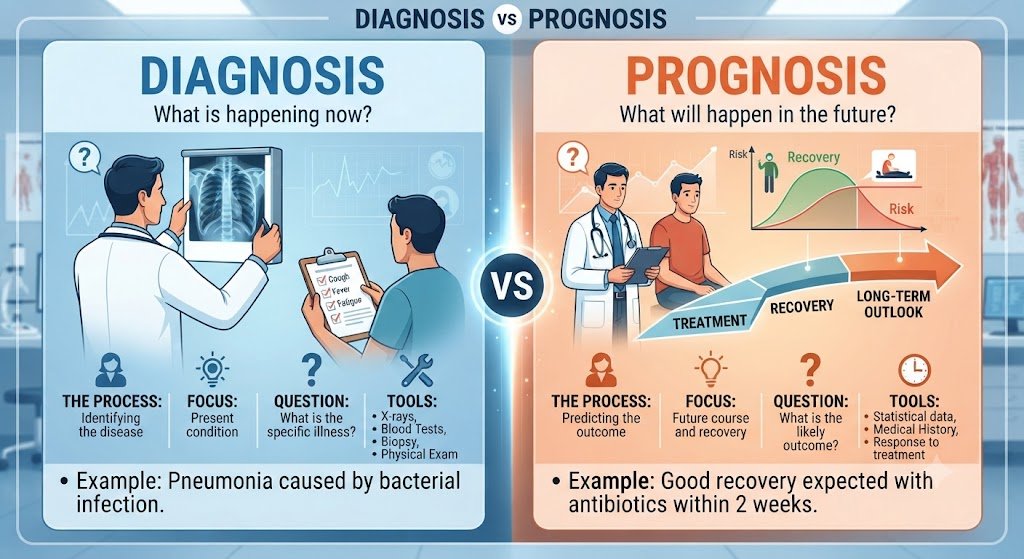
Understanding the difference between diagnosis and prognosis can make medical conversations far less confusing. A diagnosis identifies the disease, disorder, or injury affecting a patient, while a prognosis estimates how that condition may develop over time.
Put simply, diagnosis answers “What is happening?” Prognosis answers “What is likely to happen next?”
The two concepts are closely connected, but they are not interchangeable. A doctor may establish an accurate diagnosis yet remain uncertain about the prognosis because different patients with the same condition can experience very different outcomes.
This guide explains how diagnosis and prognosis are determined, why predictions are not guarantees, and which questions patients should ask their healthcare providers.
Medical note: This article provides general educational information and should not replace evaluation or advice from a qualified healthcare professional.
What Is the Difference Between Diagnosis and Prognosis?
The fundamental difference between diagnosis and prognosis is the type of medical question each term addresses.
A diagnosis is the identification of a disease, condition, or injury based on available clinical evidence. A prognosis is an informed estimate of the condition’s likely course, including possible recovery, progression, complications, recurrence, disability, or survival.
The National Cancer Institute defines diagnosis as the process of identifying a disease, condition, or injury through signs, symptoms, medical history, physical examination, and testing. It defines prognosis as the likely outcome or course of a disease, including the possibility of recovery or recurrence.
Here is the distinction at a glance:
| Medical concept | Diagnosis | Prognosis |
|---|---|---|
| Primary question | What condition does the patient have? | How is the condition likely to develop? |
| Time focus | Present or existing condition | Future course and outcome |
| Main purpose | Identify and classify the health problem | Estimate recovery, progression, or complications |
| Evidence used | Symptoms, examination, history, imaging, laboratory tests, biopsies | Diagnosis, severity, stage, age, health status, treatment response, research data |
| Level of certainty | May be confirmed, provisional, or suspected | Usually expressed as a probability or range |
| Can it change? | Yes, when new evidence appears | Yes, particularly after treatment or changes in health |
A memorable way to separate them is:
- Diagnosis: the name of the medical problem.
- Prognosis: the expected direction of the medical problem.
- Treatment: what may be done about the problem.
What Does Diagnosis Mean?
A diagnosis is a clinician’s explanation for a patient’s symptoms, signs, examination findings, and test results. It gives the health problem a medically meaningful name and helps guide the next steps in care.
Diagnosis is not always a single moment in which a doctor instantly recognizes an illness. The diagnostic process may develop over several appointments as information is collected, possible explanations are compared, and the patient’s response is observed.
The National Academies describes diagnosis as a complex, patient-centered process involving information gathering and clinical reasoning. It can continue over time rather than ending with one test or consultation.
How Doctors Reach a Diagnosis
Doctors typically combine several categories of evidence:
- Medical history: Current symptoms, previous illnesses, medications, family history, lifestyle, exposures, and recent events.
- Physical examination: Observable or measurable findings such as swelling, fever, weakness, tenderness, breathing changes, or abnormal heart sounds.
- Laboratory testing: Blood, urine, tissue, genetic, hormonal, microbiological, or other biological testing.
- Medical imaging: X-rays, ultrasound, CT scans, MRI scans, mammography, or other imaging procedures.
- Specialized procedures: Biopsy, endoscopy, cardiac testing, neurological evaluation, or pulmonary function testing.
- Clinical criteria: Established combinations of symptoms and findings used to identify particular conditions.
Medical tests may help detect a condition, establish a diagnosis, monitor its progression, evaluate treatment effectiveness, or rule out competing explanations.
What Is a Differential Diagnosis?
A differential diagnosis is a structured list of conditions that could reasonably explain a patient’s symptoms. The clinician compares these possibilities and gathers evidence to rule them in or out.
For example, chest pain could be related to:
- Heart disease
- Acid reflux
- Muscle strain
- Lung disease
- Anxiety
- Inflammation around the heart or lungs
The patient’s history, examination, electrocardiogram, blood tests, imaging, and other findings help narrow the possibilities. MedlinePlus explains that differential diagnosis is especially useful when symptoms do not have one immediately clear cause.
Types of Diagnosis
The difference between diagnosis and prognosis becomes easier to understand when you recognize that not every diagnosis has the same degree of certainty.
A clinician may use terms such as:
Provisional diagnosis: The most likely explanation based on current evidence, although confirmation is still needed.
Working diagnosis: The condition being used to guide immediate management while further evaluation continues.
Differential diagnosis: A list of plausible conditions still under consideration.
Clinical diagnosis: A conclusion based largely on symptoms, history, examination, and established clinical criteria.
Definitive diagnosis: A final conclusion supported by sufficient evidence, sometimes including blood tests, imaging, pathology, or biopsy results.
These labels matter. “Possible pneumonia” does not communicate the same certainty as “biopsy-confirmed cancer” or “laboratory-confirmed influenza.”
What Does Prognosis Mean?
A prognosis is a medically informed forecast of how an illness, injury, or disorder is likely to progress. It may address much more than whether a patient will survive.
Prognosis can include the expected:
- Duration of illness
- Likelihood of recovery
- Speed of improvement
- Risk of complications
- Probability of recurrence
- Degree of future disability
- Response to treatment
- Effect on daily activities
- Need for long-term care
- Life expectancy in serious illness
The difference between diagnosis and prognosis is especially important here: diagnosis identifies the condition, but prognosis translates that information into possible future outcomes.
Prognosis is not fortune-telling. It is a probability-based judgment derived from clinical experience, patient-specific information, and outcomes observed in groups of people with similar conditions.
What Factors Affect a Prognosis?
A doctor may consider dozens of variables before discussing a patient’s expected outlook.
Important factors include:
- The exact diagnosis
- Disease severity or stage
- How early the condition was identified
- The organs or body systems involved
- The patient’s age
- General physical health
- Other medical conditions
- Genetic or biological characteristics
- Availability of effective treatment
- Response to treatment
- Medication adherence
- Lifestyle and environmental factors
- Access to specialist care and rehabilitation
In cancer care, for example, prognosis may depend on tumor type, stage, grade, genetic features, age, general health, treatment, and patterns observed among similar patients.
The same principle applies beyond cancer. The outlook for a stroke may depend on the affected brain region, speed of treatment, initial impairment, age, rehabilitation, and additional health conditions.
Common Prognostic Terms
Healthcare professionals sometimes describe prognosis using broad terms:
- Excellent prognosis: Full recovery is highly likely.
- Good prognosis: Improvement or successful control is likely.
- Fair prognosis: The outcome is uncertain or mixed.
- Poor prognosis: Significant progression, disability, complications, or death may be more likely.
- Guarded prognosis: The clinician cannot confidently predict the outcome, often because the patient is unstable or several outcomes remain possible.
These labels can be useful, but they are imprecise. Patients should ask what a term such as “fair” or “guarded” means in their specific situation.
Diagnosis vs Prognosis: A Practical Example
Consider a patient who develops coughing, fever, chest discomfort, and shortness of breath.
After reviewing the symptoms, listening to the lungs, ordering a chest X-ray, and evaluating laboratory findings, the doctor diagnoses bacterial pneumonia. That is the diagnosis: the current medical condition has been identified.
The doctor may then explain that the patient is otherwise healthy, treatment began early, oxygen levels are stable, and improvement is expected within several days. That explanation describes the prognosis.
Now consider an older patient with the same diagnosis who also has heart failure, kidney disease, low oxygen levels, and delayed treatment. The diagnosis may still be bacterial pneumonia, but the prognosis may be less favorable.
This example reveals the central difference between diagnosis and prognosis: two patients can have the same diagnosis but substantially different expected outcomes.
Can You Have a Diagnosis Without a Clear Prognosis?
Yes. A condition may be identified accurately even when its future course remains difficult to predict.
This is common when:
- The disease is rare.
- Symptoms vary widely between patients.
- The condition has only recently been diagnosed.
- Treatment has not yet started.
- The patient has several interacting illnesses.
- Limited research is available.
- The disease may follow several distinct paths.
MedlinePlus notes that the prognosis of rare genetic conditions can be particularly difficult to estimate because relatively few affected individuals may have been studied.
A clear diagnosis therefore does not automatically produce a certain outcome.
Can a Prognosis Change?
A prognosis can change—sometimes considerably.
It may improve when a patient responds well to treatment, adopts helpful lifestyle changes, receives rehabilitation, or gains access to a more effective therapy. It may worsen if the disease progresses, complications develop, treatment stops working, or other medical problems arise.
This flexibility is another major difference between diagnosis and prognosis. A diagnosis may remain the same while the projected outcome changes repeatedly.
For instance, a person may continue to have a diagnosis of heart failure, but their prognosis may improve after effective medication, symptom stabilization, and management of contributing risk factors.
Why Early Prognostic Estimates May Be Uncertain
An early estimate is often based on incomplete information. Clinicians may need to observe treatment response, repeat tests, review pathology results, or assess how rapidly the condition changes.
A responsible prognosis is therefore commonly expressed as:
- A range rather than a single number
- A likelihood rather than a promise
- Several possible scenarios
- A short-term and long-term outlook
- An estimate that will be updated over time
Certainty should not be confused with quality. A careful doctor may communicate uncertainty because the evidence genuinely does not support a precise prediction.
Prognosis Is Not the Same as Life Expectancy
People sometimes assume prognosis is simply a prediction of how long someone will live. That is too narrow.
Life expectancy may be part of a prognosis in advanced or life-limiting illness, but many prognostic discussions focus on pain, mobility, independence, symptom control, ability to work, recurrence, fertility, cognition, or quality of life.
The National Cancer Institute describes prognosis as the expected course of a disease and the possibility of recovery or recurrence—not merely survival duration.
For a sports injury, prognosis may mean how long it will take to return to training. For depression, it might address the likelihood of symptom improvement or relapse. For a neurological disorder, it may concern future mobility and independence.
Diagnosis, Prognosis, and Prediction of Treatment Response
Three medical concepts are commonly blended together:
Diagnosis asks: What condition is present?
Prognosis asks: What is likely to happen over time?
Treatment-response prediction asks: How likely is a particular treatment to work?
Pathology literature captures this distinction as “what is it,” “how will it behave,” and “how might it respond to treatment.”
The third question matters because a generally poor prognosis does not mean every available treatment will fail. Likewise, a favorable prognosis does not prove that a specific medication is necessary or guaranteed to work.
Why the Difference Between Diagnosis and Prognosis Matters
Understanding these terms helps patients interpret medical information more accurately and participate meaningfully in decisions.
It Prevents Unnecessary Assumptions
A serious-sounding diagnosis does not automatically mean the outcome will be poor. Some significant conditions are highly treatable, especially when detected early.
Likewise, a common diagnosis is not always harmless. Its prognosis may depend on severity, complications, and the patient’s overall health.
It Improves Treatment Decisions
Prognostic information can influence whether treatment should be aggressive, conservative, immediate, preventive, rehabilitative, or focused primarily on comfort.
Clinical research has emphasized that prognosis can help identify patients who may benefit from intervention while reducing unnecessary or potentially harmful treatment for those at low risk of a poor outcome.
It Supports Realistic Planning
Patients and families may use prognostic information to plan:
- Time away from work
- Home assistance
- Rehabilitation
- Financial arrangements
- Childcare
- Future medical appointments
- Advance care planning
- Emotional and practical support
The purpose is not to remove hope. It is to make decisions with the clearest information currently available.
How Doctors Communicate Prognostic Risk
Prognosis may be communicated through words, percentages, survival statistics, risk categories, or possible scenarios.
A doctor might say:
- “Most people recover fully.”
- “There is a moderate chance of recurrence.”
- “We need to see how the condition responds during the next few weeks.”
- “Half of similar patients remain symptom-free for at least five years.”
- “The best-case and worst-case outcomes are quite different.”
Statistics describe groups, not exact individual destinies. A five-year survival rate, for example, summarizes what happened among a defined population; it cannot state with certainty what will happen to one person.
That statistical limitation is essential when discussing the difference between diagnosis and prognosis. The diagnosis may apply directly to an individual, whereas prognostic percentages are often derived from groups of patients.
Questions to Ask After Receiving a Diagnosis
Patients frequently leave appointments knowing the name of their condition but not understanding its practical meaning.
Useful questions include:
- How certain is this diagnosis?
- Which findings support it?
- Were other possible conditions considered?
- Do I need additional testing?
- How severe or advanced is the condition?
- What is the expected short-term course?
- What is the likely long-term outlook?
- Which factors could improve or worsen my prognosis?
- How will we know whether treatment is working?
- When should the diagnosis or prognosis be reassessed?
- Which symptoms require urgent medical attention?
Ask the clinician to explain percentages in absolute terms. “Your risk doubles” is much less informative than “your estimated risk increases from 2% to 4%.”
Common Misunderstandings About Diagnosis and Prognosis
“A Diagnosis Is Always Final”
Not necessarily. Diagnoses may be revised as new symptoms appear, tests are repeated, or specialists review the case.
Medicine often operates with changing evidence. Revising a diagnosis is not automatically a sign that earlier care was negligent; sometimes the condition could not reasonably be identified earlier.
“A Poor Prognosis Means Nothing Can Be Done”
A poor prognosis may indicate a higher risk of an unfavorable outcome, but treatment can still relieve symptoms, slow progression, preserve function, prevent complications, or improve quality of life.
It should never be interpreted as a complete treatment plan.
“A Good Prognosis Guarantees Recovery”
No prognosis is an absolute guarantee. A good outlook means favorable outcomes are more likely, not certain.
Individual responses can differ from group averages.
“The Diagnosis Alone Determines the Prognosis”
The diagnosis is only one variable. Disease stage, severity, biology, treatment response, age, other illnesses, and social circumstances can all influence the outcome.
This is perhaps the most practically important difference between diagnosis and prognosis for patients to understand.
Frequently Asked Questions
What is the simplest difference between diagnosis and prognosis?
A diagnosis identifies the condition a person currently has. A prognosis estimates the condition’s likely future course, including recovery, progression, complications, or recurrence.
Think of diagnosis as the medical identification and prognosis as the medical forecast.
Which comes first, diagnosis or prognosis?
Diagnosis usually comes first because clinicians need to understand what condition they are dealing with before estimating the likely outcome. However, doctors may discuss a preliminary outlook while diagnostic testing is still underway.
The prognosis becomes more individualized as the diagnosis, severity, stage, biological features, and treatment response become clearer.
Can two doctors give different prognoses for the same diagnosis?
Yes. Doctors may weigh evidence differently, have access to different information, or specialize in different aspects of the condition.
Prognosis also involves uncertainty. A second opinion can be valuable when the illness is serious, rare, rapidly progressing, or associated with several reasonable treatment options.
Does prognosis determine treatment?
Prognosis can influence treatment, but it is not the only consideration. Doctors and patients also evaluate treatment benefits, side effects, personal values, quality of life, cost, accessibility, and the patient’s goals.
Good care combines evidence with shared decision-making rather than treating a prognostic estimate as an automatic command.
Is a prognosis always accurate?
No. Prognosis is an evidence-based estimate, not a certainty. It is generally more reliable when the diagnosis is clear, the disease has been well studied, and the patient closely resembles the populations used to create the estimate.
It may be less precise for rare diseases, unusual clinical presentations, new treatments, or patients with multiple complex conditions.
Conclusion: Use Both Terms to Understand the Full Medical Picture
The difference between diagnosis and prognosis can be summarized in two questions: What condition is present, and what is likely to happen next?
Diagnosis provides the medical identity of a health problem. Prognosis adds context by estimating its future course, possible complications, treatment response, recovery, recurrence, and effect on daily life.
Neither concept should be interpreted in isolation. A diagnosis does not tell the entire future, and a prognosis is not a fixed verdict.
After receiving medical results, ask your healthcare provider to explain the certainty of the diagnosis, the factors influencing the prognosis, the available treatment options, and when the outlook will be reassessed. That conversation will give you far more useful information than either medical term alone.
