
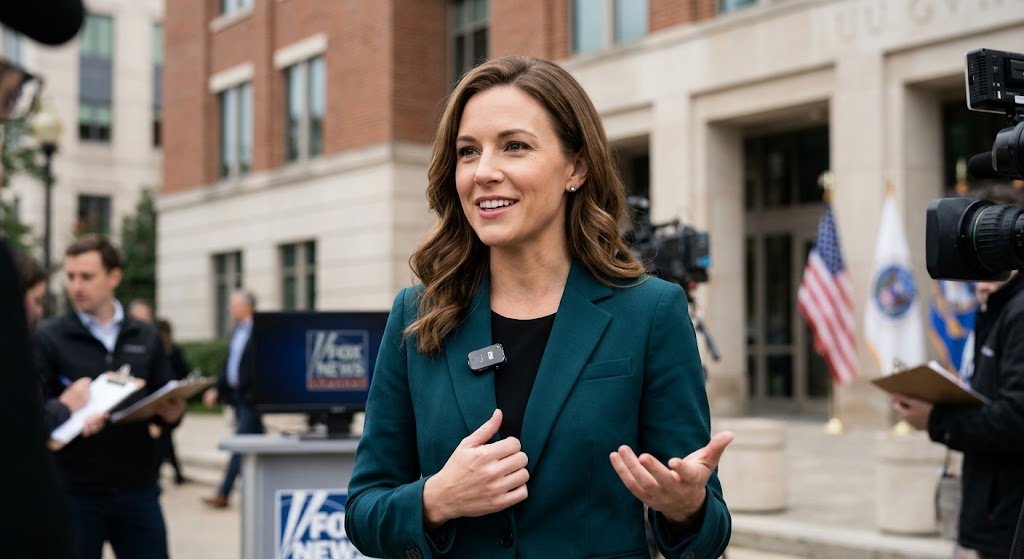
Introduction: Who Is Erin Perrine?
Erin Perrine is an American Republican political strategist, communications professional, and media commentator best known for her work in prominent Republican political organizations and presidential campaigns. She gained national recognition through her role as Director of Press Communications for Donald Trump’s 2020 presidential reelection campaign, where she helped shape the campaign’s public messaging and media engagement.
Her professional journey includes experience on Capitol Hill, Republican congressional leadership teams, Senate campaigns, and national political communications operations. She has also become recognizable to television audiences through political interviews, panel discussions, and commentary on major American political developments.
What makes Erin Perrine particularly interesting is the range of environments in which she has worked. Political communications requires more than writing press releases or appearing before cameras. It involves understanding political priorities, anticipating criticism, managing fast-moving news cycles, and translating complicated policy debates into messages that ordinary voters can understand.
Her career offers a useful case study in how political professionals build influence behind the scenes before becoming recognizable public commentators.
This article examines her background, education, professional milestones, communications experience, media presence, and broader significance in American Republican politics.
1. Erin Perrine’s Early Life and Family Background
Growing Up in Rochester, New York
Erin Perrine grew up in Rochester, New York, in a family with strong connections to public service, law, and local politics. Her grandfather, Gary E. Smith, served as a Rochester City Court judge and was involved in local government. Her great-grandfather, William A. Winfield, also had a public-service background, serving as Rochester’s chief of police between 1954 and 1962.
These family connections provided early exposure to civic institutions and political life. According to an in-depth 2020 profile published by the Rochester Beacon, Perrine even participated in her grandfather’s reelection campaign as a young child, wearing a homemade campaign shirt during a local parade.
It was an early introduction to political campaigning, although her professional ambitions would take shape much later.
provides valuable firsthand details about these formative experiences.
Her parents were both attorneys, and she grew up with three siblings. She attended several Catholic schools in the Rochester area, including the Aquinas Institute of Rochester.
The Experiences That Influenced Her Political Interests
Perrine’s childhood was not exclusively centered on politics. She participated in sports, cheerleading, and horseback riding, with equestrian activities becoming an especially important part of her early life.
One influential figure was her Girl Scout leader, Pam Baker. Baker reportedly encouraged her to consider careers in law or politics, recognizing her potential interest in public affairs.
That encouragement eventually became significant when Perrine pursued political science at the University of Connecticut. Baker helped her obtain an internship connected to the 2008 Republican National Convention.
The opportunity proved important because it introduced her to the practical workings of national political organizations.
An important takeaway from her early background: Her career did not begin with television appearances or national political recognition. It developed through local political exposure, educational opportunities, networking, and direct campaign experience.
2. Erin Perrine’s Education and Academic Background
Education played an important role in preparing Perrine for a career in political communications.
She attended the University of Connecticut, commonly known as UConn, where she studied political science. She graduated in 2010, according to the Rochester Beacon’s reporting.
Political science provided a useful academic foundation for understanding:
-
American government and constitutional institutions.
-
Political parties and electoral systems.
-
Legislative processes and congressional leadership.
-
Public policy and political decision-making.
-
Campaign organization and voter behavior.
-
Political messaging and the relationship between government and the media.
Her university experience also created opportunities to participate in political activities outside the classroom.
The 2008 Republican National Convention internship was particularly significant. It exposed her to national political operations before she entered the professional workforce.
Why Her Political Science Background Matters
Political communications is a specialized profession. Effective communicators need to understand not only how to write but also how political institutions operate.
A press secretary covering Congress must understand legislative procedures, party leadership, committee activity, and the political consequences of government decisions.
Similarly, someone working on a presidential campaign needs to recognize how national issues influence voter perceptions and how competing political narratives develop.
Perrine’s academic background, combined with practical campaign experience, provided a foundation for these responsibilities.
Her career demonstrates an important distinction: political knowledge and communication ability are most valuable when developed together.
3. Erin Perrine’s Early Political Career
Entering Republican Politics in 2008
Perrine’s professional political journey began taking shape during the 2008 election cycle.
Her Republican National Convention internship introduced her to campaign operations, political networking, and the communications infrastructure surrounding a major national political event.
The experience helped establish connections that would become useful throughout her career.
Rather than immediately pursuing a high-profile Washington position, she moved into campaign work after graduating from UConn.
Working on Ron Johnson’s 2010 Senate Campaign
One of her earliest significant professional assignments was working on Republican Ron Johnson’s 2010 U.S. Senate campaign in Wisconsin.
Johnson challenged Democratic incumbent Russ Feingold and won the election, becoming a Republican senator.
For a developing political communications professional, a competitive Senate campaign offered valuable experience in:
-
Developing candidate messaging.
-
Communicating campaign priorities.
-
Responding to political developments.
-
Supporting media outreach.
-
Understanding voter concerns.
-
Working within a time-sensitive campaign structure.
Campaign environments are demanding. Public messages must be consistent, accurate, and responsive to rapidly changing circumstances.
This experience helped establish the practical skills that would later define her professional identity.
Working With Paul Ryan
Perrine subsequently worked on Representative Paul Ryan’s 2012 reelection campaign in Wisconsin.
Ryan later became Speaker of the U.S. House of Representatives, making the experience another important connection to Republican congressional leadership.
Working on campaigns involving established political figures offered exposure to the relationship between electoral strategy, legislative priorities, and public communication.
It also helped expand her professional network within Republican politics.
Experience in the New York State Assembly
Following her initial campaign work, Perrine served as press secretary for the Republican conference in the New York State Assembly in Albany.
This position represented a transition from electoral campaigning to institutional political communications.
Unlike campaign work, legislative communications requires ongoing attention to policy debates, official announcements, political negotiations, and the activities of elected representatives.
It also demands an understanding of how local and state-level political decisions connect with broader national discussions.
That experience contributed another layer to her professional development.
4. Erin Perrine’s Career With Kevin McCarthy
One of the most important milestones in Perrine’s professional development was her work with Republican congressional leadership.
In 2017, she became national press secretary for then-House Majority Leader Kevin McCarthy of California. She continued working in that capacity until joining the Trump reelection campaign.
Her responsibilities involved managing press relations and helping communicate the Republican leadership’s positions on congressional developments.
A 2018 Washington Examiner interview offers additional insight into her day-to-day responsibilities. Perrine explained that her work involved media bookings, pitching stories, preparing for interviews, and communicating House floor schedules and weekly legislative developments.
These responsibilities illustrate the breadth of a congressional press secretary’s job. It is not simply about issuing statements. It involves coordinating information, maintaining relationships with journalists, and ensuring that political leaders communicate effectively.
What She Learned From Working With Kevin McCarthy
Her congressional experience provided several important professional advantages:
-
Legislative communications: She gained direct experience explaining congressional activity and Republican policy positions.
-
Media relationship management: Regular interaction with reporters helped develop her understanding of political journalism.
-
Message discipline: Congressional leadership requires consistency when communicating complicated legislative issues.
-
Rapid response: Political developments frequently demand immediate clarification or a carefully coordinated response.
-
Leadership communications: Working with a senior Republican leader provided insight into the relationship between political strategy and public messaging.
This experience was especially relevant to her later responsibilities in presidential campaign communications.
A congressional press office and a presidential campaign are different environments, but both require professionals who can operate under pressure while maintaining a recognizable message.
5. Erin Perrine and the Donald Trump 2020 Presidential Campaign
Joining the Trump Campaign in 2019
In March 2019, Perrine joined Donald Trump’s 2020 presidential reelection campaign as a deputy director of communications.
The appointment was reported by Fox News on March 6, 2019. She was recruited alongside other communications professionals as the campaign expanded its press operation in preparation for the presidential election.
Her experience working for Kevin McCarthy and Senator John Thune made her a logical addition to a campaign that needed people familiar with congressional leadership, Republican messaging, and national media relations.
Fox News+1
Becoming Director of Press Communications
By June 2020, Perrine had advanced to Director of Press Communications for the Trump reelection campaign.
This was a significant professional achievement.
The position placed her in a highly visible communications role during one of the most politically consequential election cycles in modern American history.
Her responsibilities included representing campaign positions, communicating with journalists, coordinating press messaging, and helping explain the campaign’s political priorities.
The role also meant operating in an environment characterized by constant media scrutiny, competing narratives, and rapidly changing political developments.
A 2020 Washington Post interview featured Perrine discussing the Republican National Convention and the campaign’s messaging priorities. The interview demonstrated how campaign communications professionals help explain a candidate’s public message to national audiences.
The Washington Post+1
Her Role During the 2020 Election
The 2020 presidential campaign presented substantial communications challenges.
The country was dealing with the COVID-19 pandemic, economic uncertainty, debates over public health policy, racial justice protests, and an increasingly polarized political environment.
Each issue created new demands on campaign spokespeople.
Perrine’s work required balancing several communication objectives:
-
Explaining the administration’s record.
-
Responding to criticism from political opponents.
-
Presenting campaign arguments to national journalists.
-
Preparing for interviews and press appearances.
-
Reinforcing campaign talking points.
-
Maintaining consistent messaging across different media platforms.
The position also placed her close to senior campaign decision-makers.
A detailed 2020 Rochester Beacon interview described her direct interactions with Trump, including a congratulatory telephone call following a television interview and her participation in a White House campaign communications briefing.
Rochester BeaconRochester Beacon
Why the Position Increased Her Public Recognition
Before the 2020 election cycle, Perrine’s professional reputation was largely associated with political offices and campaign organizations.
The Trump campaign changed that.
As Director of Press Communications, she became one of the recognizable public-facing representatives of the reelection operation.
Television interviews allowed audiences to associate her name with Republican campaign messaging, political debate, and the Trump administration’s communications strategy.
This transition from behind-the-scenes political work to national media visibility was an important turning point in her career.
6. Erin Perrine’s Work With Senator Ted Cruz
Following her work with the Trump campaign, Perrine served as communications director for Republican Senator Ted Cruz of Texas.
This position expanded her experience beyond presidential campaigning and congressional leadership communications.
Senatorial communications involves a different set of responsibilities from presidential campaign press operations.
A senator’s communications team must address legislative proposals, committee activity, national political controversies, constituency concerns, and the senator’s public positions on major policy questions.
The work also requires careful coordination between political messaging and legislative developments.
Perrine’s experience with congressional leadership made this transition particularly relevant.
She already understood the importance of communicating complicated policy issues in language that could be understood by reporters and the wider public.
Her work with Cruz further strengthened her experience in high-profile Republican political communications.
7. Erin Perrine and the Never Back Down Political Organization
Another important chapter in Perrine’s career came in March 2023, when she joined Never Back Down, a super PAC supporting Florida Governor Ron DeSantis’s potential 2024 presidential campaign.
CBS News reported that she would serve as the organization’s communications director.
The appointment attracted attention because Perrine had previously worked for Donald Trump’s 2020 presidential campaign. Her move to a pro-DeSantis organization demonstrated that experienced Republican communications professionals could move between competing political operations within the same party.
CBS News
Understanding Never Back Down
Never Back Down was an independent political organization established to support DeSantis’s presidential ambitions.
Super PACs can raise and spend funds independently to influence elections, subject to applicable campaign-finance rules. They are not the same as official candidate committees.
As communications director, Perrine was associated with an organization seeking to establish DeSantis as a serious alternative to Trump among Republican voters.
The political challenge was substantial.
The Republican presidential primary involved competing personalities, policy priorities, campaign organizations, and different visions for the party’s future.
Communications strategy was central to the effort to present DeSantis’s candidacy to voters.
Why This Career Move Matters
Her involvement with Never Back Down is worth examining because it demonstrates professional adaptability.
Perrine’s experience included working for Trump, serving a prominent Republican senator, and joining an organization supporting a potential Trump primary challenger.
That sequence illustrates how political communications professionals may be valued for their operational experience even when political organizations have competing objectives.
It also highlights the importance of understanding the difference between an individual’s professional expertise and the political positions of the organizations they represent.
8. Erin Perrine’s Television Career and Media Appearances
Television appearances have become an important part of Perrine’s public profile.
Her background in campaign communications gives her a perspective that differs from that of journalists, academic political scientists, and elected officials.
She has experience explaining how campaign organizations develop messages, prepare spokespeople, respond to criticism, and engage with the national press.
According to her current professional website, she appears on networks and programs including:
-
Fox News
-
CNN
-
NewsNation
-
Newsmax
-
HBO’s Real Time with Bill Maher
-
Amazon Prime’s Election Night programming
Her official website also highlights her work as a political analyst and communications consultant. These are professional descriptions published by her own organization rather than independent assessments of her standing in the industry.
Crisis Communications & Media Training+1
What Makes Her Television Commentary Distinctive?
Her professional experience gives her familiarity with the mechanics of political messaging.
When discussing an election, for example, she can draw on experience with:
-
Campaign communications planning.
-
Political advertising and message development.
-
Candidate positioning.
-
Press strategy.
-
Republican Party dynamics.
-
Interview preparation.
-
Political crisis management.
This background can help audiences understand not only what politicians are saying but also why particular messages are being emphasized.
There is an important distinction, however, between political analysis and neutral journalism.
As a Republican strategist and commentator, Perrine brings a recognizable political perspective to discussions. Readers and viewers should consider that professional background when evaluating her commentary.
Her Appearance on Real Time With Bill Maher
Her television experience also includes appearances on HBO’s Real Time with Bill Maher.
The program is known for discussions involving political disagreements, cultural issues, and public policy.
Participation in this kind of format requires a different communication approach from delivering prepared campaign statements.
Guests must respond to challenges, defend arguments, and explain their positions in a conversational setting.
For a communications professional, such appearances offer opportunities to demonstrate debate skills and the ability to respond under pressure.
9. Erin Perrine’s Current Professional Identity: Erin Maguire
An important detail for anyone researching Erin Perrine is that she now uses the professional name Erin Maguire.
Her current official website is branded Erin Maguire and identifies her as a political analyst, GOP strategist, and communications consultant.
This matters for search intent and biographical accuracy. People searching for Erin Perrine may encounter more recent professional information under Erin Maguire.
The two names refer to the same political communications professional, not two separate commentators. Her official website provides continuity between her earlier political career and her current professional identity.
Erin Maguire+1
Her Work as a Political Communications Consultant
Her current professional website describes several areas of expertise:
1. Crisis communications
Helping political and public-affairs clients respond to difficult situations, manage reputational risks, and communicate clearly during controversies.
2. Media training
Preparing candidates and public figures for interviews, challenging questions, television appearances, and other high-pressure communications situations.
3. Message development
Creating consistent narratives that communicate a client’s priorities and help distinguish their positions from those of competitors.
4. Strategic communications
Developing longer-term approaches to public messaging, political positioning, and media engagement.
These services reflect a natural progression from her earlier campaign and congressional roles.
A political communications director works within an organization to advance its message. A consultant can apply similar skills across multiple clients and projects.
Her Professional Website
Her official website, Erin-Maguire.com, provides information about her background, television appearances, consulting services, and speaking opportunities.
It is also the most useful primary source for readers seeking current professional information rather than relying exclusively on older articles published under the Perrine surname.
10. Erin Perrine’s Communication Style and Professional Strengths
One of the most interesting aspects of Perrine’s career is the communication expertise she has developed through years of working in political environments.
Political communication is not simply about persuading people to agree with a particular position. It involves understanding audiences, choosing appropriate language, responding to criticism, and maintaining credibility when public attention is intense.
Her professional experience highlights several important capabilities.
Message Discipline
Political organizations often face situations in which different representatives communicate about the same issue.
Without coordination, their statements can contradict one another, creating confusion and weakening the organization’s position.
Message discipline involves ensuring that public-facing representatives understand the central argument and communicate it consistently.
Rapid Response Communications
Political controversies can develop within minutes.
A successful communications operation needs to identify emerging stories, verify information, prepare responses, and communicate with journalists before inaccurate narratives become established.
Perrine’s campaign and congressional experience exposed her to these demands.
Media Relations
Building productive relationships with journalists is another important part of political communications.
Press secretaries must understand how newsrooms work, what information reporters need, and how to present an organization’s position clearly.
Her experience arranging interviews, preparing political leaders, and participating in television discussions provides a practical foundation for this work.
Crisis Management
Crisis communications requires more than delivering a prepared statement.
It involves assessing reputational risks, understanding the concerns of different audiences, anticipating difficult questions, and deciding when an organization should respond publicly.
These are among the areas of expertise highlighted on Perrine’s current professional website.
Crisis Communications & Media Training+1
11. Personal Life, Interests, and Public Profile
Although much of the public interest in Perrine concerns her political career, some readers also want to understand the person behind the professional profile.
Her official website provides a limited amount of personal information.
She identifies as a lifelong Buffalo Bills fan and describes interests that include golf, college football, college basketball, television entertainment, and spending time with family and friends.
She also identifies as a University of Connecticut graduate and former member of the university’s equestrian team.
Her website states that she lives in Northern Virginia with her husband, Conor, and their two dogs.
Crisis Communications & Media Training
Why Personal Information Should Be Evaluated Carefully
There is considerable online content about the personal lives of political commentators.
However, not every published claim is reliable. Some websites repeat outdated information, confuse professional biographies, or present unverified personal details as established facts.
For an accurate biography, priority should be given to:
-
Information published by the individual herself.
-
Reputable news organizations.
-
Direct interviews.
-
Verifiable professional records.
-
Official organizational biographies.
This approach is especially important when researching Erin Perrine, because older professional records use her former surname while newer information appears under Erin Maguire.
12. Erin Perrine’s Influence on Modern Political Communications
Perrine’s career provides a useful example of how political communications has evolved in the United States.
Political messaging once relied heavily on traditional newspapers, television interviews, radio broadcasts, and formal press conferences.
Those channels remain important. But political organizations now operate in a much faster and more fragmented media environment.
Social media, online news platforms, podcasts, digital advertising, and round-the-clock television coverage have changed how campaigns communicate.
The Growing Importance of Strategic Messaging
Modern campaigns must communicate with multiple audiences simultaneously.
A message that works in a television interview might need a different format for social media. A policy explanation intended for journalists may require simplification before it can reach voters unfamiliar with legislative procedures.
Communications professionals therefore need to understand:
-
Audience segmentation.
-
Digital media distribution.
-
Political narrative development.
-
Reputation management.
-
Interview preparation.
-
Rapid-response strategy.
-
Consistent messaging across platforms.
Perrine’s progression from congressional press secretary to presidential campaign spokesperson and political communications consultant illustrates how experience in traditional political institutions can translate into broader media work.
The Relationship Between Political Strategy and Public Perception
Political campaigns do not operate in a vacuum.
Their messages compete with opposition arguments, breaking news, public opinion, and independent media coverage.
The challenge is not simply getting a statement published. It is ensuring that the intended message is understood and considered by the audience.
This makes political communications an important part of electoral strategy.
Her professional trajectory demonstrates how experienced communicators can become influential participants in political discussions without holding elected office themselves.
That distinction is important: political influence does not always require a position in government.
13. What Makes Erin Perrine’s Career Worth Studying?
There are several lessons that aspiring political professionals, communications students, and public relations specialists can draw from her career.
1. Start with practical experience.
Her early work on political campaigns gave her direct exposure to the realities of electoral politics.
2. Develop relationships across political institutions.
Experience with campaigns, state government, congressional leadership, and national organizations expanded her professional perspective.
3. Learn to communicate complicated subjects clearly.
Political communications professionals must translate legislative and policy discussions into accessible language.
4. Become comfortable with public scrutiny.
Campaign spokespeople operate in environments where their statements are constantly analyzed, challenged, and sometimes criticized.
5. Build transferable expertise.
Media relations, crisis communications, strategic messaging, and interview preparation are useful beyond electoral politics.
These lessons are not exclusive to Republican politics. They apply broadly to public relations, government affairs, corporate communications, and political consulting.
For readers interested in pursuing similar careers, her experience suggests that practical campaign work and strong communication skills can provide a valuable starting point.
14. Erin Perrine: Career Timeline
The following timeline brings together the major publicly documented milestones in her professional journey.
| Year | Career milestone |
|---|---|
| 2008 | Internship experience connected to the Republican National Convention |
| 2010 | Graduated from the University of Connecticut |
| 2010 | Worked on Ron Johnson’s Wisconsin Senate campaign |
| 2012 | Worked on Paul Ryan’s reelection campaign |
| Following years | Served as press secretary for the New York State Assembly Republican conference |
| 2017 | Became national press secretary for Kevin McCarthy |
| March 2019 | Joined Trump’s 2020 reelection campaign |
| June 2020 | Became Director of Press Communications |
| 2021 onward | Continued developing her political communications career, including work associated with Senator Ted Cruz |
| March 2023 | Joined Never Back Down as communications director |
| 2024 onward | Continued appearing in political media and commentary |
| 2025–2026 | Developed her professional identity and consulting presence under the name Erin Maguire |
The early career milestones are documented in the Rochester Beacon’s reporting, while her Trump campaign and Never Back Down appointments were covered by Fox News and CBS News. Her more recent professional identity is documented on her official website.
Rochester BeaconRochester Beacon+3
15. Frequently Asked Questions About Erin Perrine
1. Who is Erin Perrine?
Erin Perrine is an American Republican political strategist, communications professional, and media commentator. She became nationally recognized for serving as Director of Press Communications for Donald Trump’s 2020 presidential reelection campaign.
Her professional experience also includes working for Kevin McCarthy, Senator John Thune, Senator Ted Cruz, and the Never Back Down political organization. She now uses the professional name Erin Maguire and works as a political analyst and communications consultant.
2. What did Erin Perrine do for Donald Trump?
Erin Perrine joined Donald Trump’s 2020 reelection campaign in March 2019 as a deputy communications director. By June 2020, she had become Director of Press Communications.
Her responsibilities included managing press communications, representing campaign positions, participating in media interviews, and helping communicate the campaign’s political messages.
She became one of the recognizable public-facing communications professionals associated with the reelection operation.
3. Did Erin Perrine work for Kevin McCarthy?
Yes. Perrine served as national press secretary for Kevin McCarthy, who was a senior Republican congressional leader and later became Speaker of the House.
She joined his communications operation in 2017. Her responsibilities included coordinating press activity, arranging interviews, preparing media appearances, and communicating congressional developments.
This experience helped prepare her for her subsequent position with the Trump presidential campaign.
4. Did Erin Perrine work for Ron DeSantis?
Yes. In March 2023, CBS News reported that Perrine had joined Never Back Down, a super PAC supporting Florida Governor Ron DeSantis’s potential 2024 presidential campaign.
She was appointed communications director, helping the organization communicate its political objectives and support for DeSantis.
Her involvement attracted attention because she had previously worked on Trump’s 2020 reelection campaign.
5. Is Erin Perrine now known as Erin Maguire?
Yes. Erin Perrine now uses the professional name Erin Maguire.
Her current professional website, Erin-Maguire.com, identifies her as a political analyst, GOP strategist, and communications consultant.
People searching for her earlier political career may still find extensive information under the name Erin Perrine, particularly in articles about the 2020 presidential election and her work with Republican congressional leaders.
The two names refer to the same professional, and using both names when researching her career helps readers locate older and newer information.
Conclusion: Understanding Erin Perrine’s Political and Professional Journey
The career of Erin Perrine illustrates how political communications professionals can build national recognition through a combination of campaign experience, institutional knowledge, media expertise, and strategic messaging.
From her early political exposure in Rochester and her studies at the University of Connecticut to her work with Kevin McCarthy and Donald Trump’s 2020 campaign, her professional journey reflects a steady progression through important Republican political organizations.
Her subsequent work with Senator Ted Cruz and Never Back Down expanded that experience, while her television appearances introduced her communications expertise to a wider audience.
Today, she operates publicly under the name Erin Maguire, with a professional focus on political analysis, media training, crisis communications, and strategic consulting.
For readers who want to understand her career more deeply, the next step is to explore her original interviews, professional website, and reporting from established news organizations. These sources provide a much stronger foundation than recycled biographical claims or unverified online speculation.
Start with her official professional website, then explore the Rochester Beacon’s detailed career profile and the CBS News report on her Never Back Down appointment.
Together, these sources offer a clearer picture of her professional evolution and place in American political communications.
