
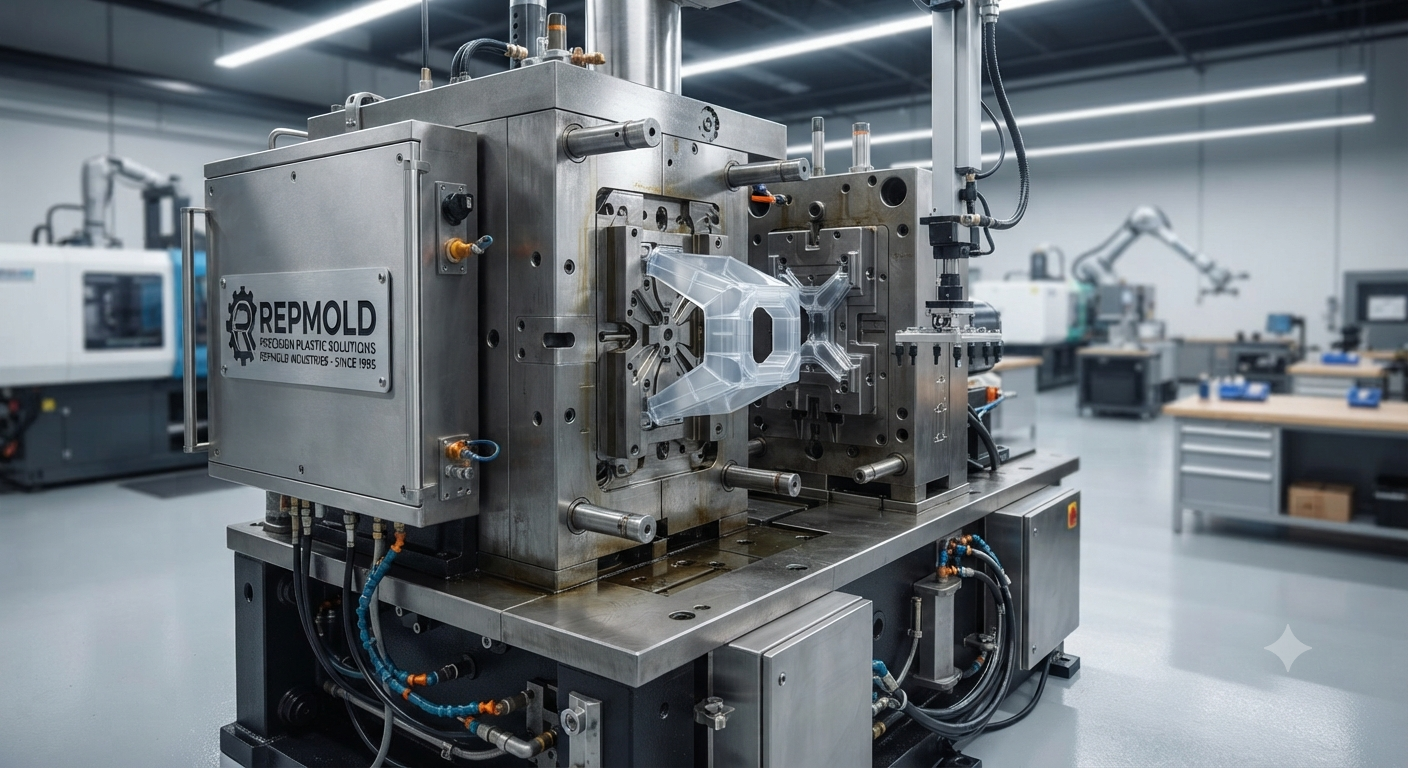
Repmold is appearing across technology and manufacturing websites, yet the term is rarely defined with the precision engineers, buyers and product teams need. Some pages describe it as a digital-first method that combines CAD, rapid prototyping, mold replication and automated production. Others use the name as though it were a specific machine, proprietary platform or revolutionary material.
That inconsistency matters. A company considering tooling investment cannot base a purchasing decision on an attractive label alone. It needs to know the actual process, materials, tolerances, cycle life, inspection plan and supplier capability behind the claim.
This guide separates the useful manufacturing ideas associated with repmold from unsupported marketing language. It explains what the term can reasonably mean, how the related workflow functions, where it may create value and what evidence a credible supplier should provide.
What Is Repmold?
The most practical definition is a non-standard online term for a digitally supported mold replication or rapid-tooling workflow. In this interpretation, repmold connects several established technologies: computer-aided design, 3D scanning, injection-molding simulation, additive manufacturing, CNC machining, mold repair and data-based quality control.
That definition is more defensible than calling it a single patented technology. As of July 2026, general web results show many publishers giving the word similar but not identical meanings, while the website using the exact-match domain is a broad editorial blog rather than an identifiable mold-equipment manufacturer.
The term should therefore be treated as a descriptive umbrella, not an automatic certification of performance. The underlying methods may be real and valuable, but the label itself does not prove precision, sustainability, automation or production readiness.
Is Repmold an Official Manufacturing Standard?
There is no clear evidence in the reviewed public sources that repmold is an ISO-defined process, an ASTM category or a universally accepted engineering term. ISO does publish detailed standards covering injection-molding machines, test-specimen molds, shrinkage measurement and reproducible molding conditions, but those documents use recognised terminology such as injection moulding, not this newer label.
This does not make every use of the word misleading. Industries often adopt informal language before definitions become stable. However, engineers should translate the name into specific technical questions:
- Is the supplier discussing rapid tooling, mold copying, mold repair or conventional injection molding?
- Is the tool made from aluminium, steel, polymer, silicone, sand or a hybrid material?
- Is production intended for prototypes, bridge runs or high-volume manufacturing?
- Which dimensional, cosmetic and mechanical requirements will be inspected?
- What evidence supports claims about cost, waste, cycle time and tool life?
A useful proposal should answer those questions without relying on the term alone.
How the Repmold Workflow Typically Works
Although suppliers may use different equipment, a credible workflow can be organised into seven connected stages.
1. Capture the Part or Existing Tool
The process starts with a reliable digital reference. That may be an original CAD model, a 3D scan of a physical component or measurement data from an existing mold.
Scanning is particularly useful when legacy tooling exists but the original design files are missing. NIST has noted that 3D scanning can support replication of real objects without recreating every feature manually in CAD, although scan cleanup and engineering validation are still required.
2. Rebuild and Validate the Geometry
Engineers convert the captured data into a manufacturable model. They repair surfaces, define draft angles, check wall thickness, set shrinkage allowances and separate the geometry into mold components.
This step is where many low-quality explanations become unrealistic. A scan is not automatically a production-ready tool design. Functional surfaces, gates, runners, vents, ejector locations, cooling channels and parting lines must be engineered for the selected material and molding process.
3. Simulate Material Flow and Cooling
Modern mold-development teams can simulate how molten material fills the cavity, where weld lines may form, whether air traps are likely and how the part may warp during cooling.
Autodesk states that molding simulation can identify design issues affecting finished-part quality. It can also help evaluate cooling efficiency, material choice, manufacturability and cycle-time opportunities.
Simulation does not eliminate physical trials. It can, however, reduce avoidable iterations before metal is cut.
4. Select the Tooling Route
The correct method depends on volume, geometry, temperature, pressure, surface finish and expected tool life. Options may include:
- CNC-machined aluminium for prototypes and lower-volume production
- Hardened steel for demanding, repeatable production
- Additively manufactured inserts for complex internal channels
- Printed polymer tooling for carefully limited prototype applications
- Silicone molds for casting urethane or decorative components
- Repair or refurbishment of an existing mold when the base tool remains usable
NIST reports that additive manufacturing can reduce the time and expense of producing certain molds and cores. It also describes additive methods used for rapid tooling, although those advantages are application-dependent rather than universal.
5. Manufacture and Finish the Mold
The mold or insert is printed, machined, cast or repaired, then finished to the required specification. Finishing may include grinding, polishing, heat treatment, coating, texturing and fitting of standard mold components.
Precision comes from the entire process chain. A highly accurate digital model cannot compensate for unsuitable material, poor machine calibration, weak thermal control or careless finishing.
Tooling material must also match the planned production environment. A soft prototype mold may be fast to create, but it may not tolerate abrasive polymers, high temperatures or extended production cycles.
6. Run Trials and Correct Defects
The first molded parts are inspected for short shots, flash, sink marks, warpage, weld lines, burns, dimensional drift and cosmetic variation.
Process parameters such as melt temperature, mold temperature, injection pressure, holding pressure and cooling time are then adjusted. Gate position, venting or cooling design may also need to be revised.
Recognised test methods matter here. ISO standards address reproducible injection-molding conditions and the measurement of molding and post-molding shrinkage, showing why controlled validation is more meaningful than broad claims of “perfect replication.”
7. Release, Monitor and Maintain Production
Once approved, the process moves into controlled production. The team should retain revision history, setup parameters, inspection records, maintenance intervals and non-conformance data.
Mold wear should be monitored before it creates dimensional or cosmetic defects. Critical inserts, ejector components and wear surfaces may require preventive replacement.
This final stage determines whether repmold delivers repeatability in practice. Digital design may accelerate development, but stable output still depends on process discipline.
Core Benefits of Repmold When Properly Applied
The strongest benefits come from combining established digital tools rather than from the name itself.
Faster Tool Development
Digital models, simulation and rapid-tooling methods can shorten the path from concept to trial parts. NIST specifically identifies reduced tool-development time and cost as potential advantages of additive manufacturing for molds, cores, fixtures and related tooling.
The size of the saving depends on part complexity, supplier capacity and how many redesign cycles are avoided. A basic tool may not gain much from a complicated digital workflow, while a complex tool could benefit substantially.
Better Design Feedback
A connected workflow allows product designers, mold engineers and production teams to review the same geometry earlier. Problems involving draft, thickness, filling or cooling can be identified before a full production tool is completed.
This improves decision quality. It does not guarantee that the first design will work.
The greatest benefit often comes from resolving manufacturability problems before tooling investment becomes difficult to reverse.
Economical Bridge Production
For some products, an intermediate tool can support market testing while hardened production tooling is being built. This is valuable when a business needs functional parts for certification, investor demonstrations, customer trials or early sales.
Bridge production can also reduce launch risk. A company can test demand before committing to an expensive multi-cavity production mold.
The crucial calculation is cost per acceptable part, not tooling price alone.
Support for Complex Tool Features
Additive manufacturing may enable tooling features that are difficult to machine conventionally, including internal geometries and application-specific inserts.
Government-backed manufacturing programmes have demonstrated hybrid additive and machining approaches for injection-mold tooling intended for scaled production.
Complex cooling channels may improve temperature control in suitable applications. However, the performance of a printed insert still depends on material properties, density, finishing and connection design.
More Informed Maintenance and Replication
A digitised mold record can help teams document wear, compare revisions and recreate damaged components. This is especially useful for legacy equipment or products that must remain available for many years.
The benefit is strongest when the data includes material specifications, tolerances, heat treatment, surface requirements and inspection results—not merely a scan file.
Limitations and Risks Buyers Should Understand
Repmold is not automatically cheaper, greener or more accurate than traditional tooling. Those outcomes must be measured.
Tool life can be limited. A fast-produced aluminium or polymer tool may suit a short run but fail economically at higher volumes. Production pressure, resin abrasiveness, glass-fibre content and temperature all affect wear.
Surface finish may require extensive work. Printed tools and inserts often need machining, sealing or polishing before they can produce demanding cosmetic surfaces.
Digital copying can reproduce defects. If a worn component is scanned without correcting deformation or damage, the new mold may preserve the wrong geometry.
Simulation depends on input quality. Incorrect material data, boundary conditions or assumptions can produce confident-looking but weak predictions.
Complex systems require skilled staff. Scanning, CAD repair, mold engineering, simulation, machining and process validation are separate competencies. Buying software does not automatically create those skills.
Intellectual-property risks can increase. Digital mold files are easier to transfer than physical tooling. Buyers should establish clear ownership, storage and access controls.
Sustainability claims may ignore the full system. Less scrap in one stage does not automatically mean lower life-cycle impact. Energy use, failed trials, tool replacement, transport and end-of-life treatment also matter.
NIST’s sustainability work emphasises the importance of performance metrics rather than broad assumptions about additive manufacturing.
Repmold vs Traditional Injection Molding
Traditional injection molding is a production process in which heated material is injected into a mold, cooled and ejected. It is well established, highly scalable and supported by recognised machine-safety and testing standards.
Repmold, by contrast, is best understood as a way of describing the digital development, replication or rapid creation of the tooling around molding. It does not replace injection molding. It may change how the tool is designed, produced, repaired or validated.
The distinction is simple:
- Injection molding describes how parts are formed.
- Rapid tooling describes faster methods for producing tools.
- Mold replication describes recreating an existing mold or geometry.
- Mold repair restores damaged tooling.
- Reverse engineering converts an existing physical item into usable design data.
- Repmold may combine several of these ideas, but its exact scope must be defined by the provider.
A supplier that cannot explain the distinction may be using the keyword primarily for marketing.
Repmold vs 3D Printing
Direct 3D printing creates the final part layer by layer. A mold-based route creates tooling first and then uses that tooling to manufacture repeated parts.
Direct printing can be attractive for highly customised designs, low quantities and complex internal geometry. Molding may become more economical when identical parts are needed repeatedly and the tooling cost can be spread across the production run.
The two approaches are not always competitors. A manufacturer may print:
- A prototype for design review
- A master pattern for casting
- A temporary mold
- A metal mold insert
- A jig or inspection fixture
- A cooling-channel component
The production parts may then be molded using a different material. This hybrid workflow is one of the more credible interpretations of repmold.
Where Repmold Can Be Useful
The approach is most relevant where speed, revision control or tooling recovery matters.
Product Prototypes and Pilot Runs
Startups and development teams can use rapid molds to test real production materials, assembly fit, user handling and finishing.
This may provide more representative feedback than a display-only printed prototype. It can also reveal shrinkage, filling and ejection problems that are difficult to predict from appearance alone.
Replacement of Legacy Tooling
Manufacturers may need to recreate a discontinued insert, cavity or spare part when drawings are incomplete. Scanning, metrology and reverse engineering can accelerate the reconstruction.
The final design must account for wear in the original. Copying a damaged tool without correction can create a new tool with the same defects.
Historical process records are valuable. They can show whether unexpected dimensions were intentional or caused by deterioration.
Automotive and Consumer Components
Shorter model cycles create demand for fast design changes, service parts and pre-production testing.
The method can support brackets, housings, clips, interior components and other suitable parts when the tooling route matches the expected volume. Consumer-product teams may also use bridge tooling to test colour, texture, assembly and market response.
Medical and Aerospace Development
These sectors may benefit from digital traceability and precise prototyping. They also require stricter documentation, material control, risk management and validation.
A fashionable process name cannot replace regulatory approval, customer specifications or a controlled quality-management system.
Suppliers should be evaluated for sector-specific experience rather than general manufacturing claims.
Custom and Low-Volume Products
Personalised products, specialist equipment and niche replacement parts may not justify expensive long-life tooling.
A carefully selected bridge or soft-tooling method can make low-volume production more practical. The economics are strongest when the customer needs production-grade materials but not millions of identical units.
Mold Repair and Production Recovery
When an important production tool is damaged, recreating a failed insert from digital records may reduce downtime. Repair methods could involve machining, welding, additive deposition or replacement of a modular component.
The repair must still be inspected and trialled. Restoring the shape does not automatically restore hardness, thermal performance or fatigue resistance.
How to Evaluate a Repmold Supplier
Ask for evidence that connects marketing promises to manufacturing capability.
- Request the process definition. The supplier should explain exactly what it means by repmold and identify every major production step.
- Specify the target volume. Tooling for 50 parts is not equivalent to tooling for 500,000.
- Review material compatibility. Confirm resin, reinforcement, operating temperature, chemical exposure and surface requirements.
- Demand measurable tolerances. Replace words such as “high precision” with drawings, inspection methods and acceptance limits.
- Ask for tool-life assumptions. Obtain the expected number of cycles and the conditions that could reduce it.
- Examine sample reports. Look for dimensional inspection, first-article approval, process capability and defect documentation.
- Verify equipment and skills. Determine whether design, scanning, simulation, machining and molding are completed internally or outsourced.
- Compare total landed cost. Include engineering changes, trials, finishing, scrap, maintenance, freight and replacement tooling.
- Protect intellectual property. Clarify ownership of scans, CAD files, mold designs, process data and physical tooling.
- Request relevant case studies. Examples should involve similar materials, tolerances, volumes and part complexity.
A credible supplier will welcome technical questions. Vague answers are a warning sign.
What Does Repmold Cost?
There is no responsible universal price because the term does not identify one fixed process.
Cost depends on part size, cavity count, tolerance, mold material, surface finish, complexity, cooling design, resin, expected cycles and inspection requirements.
For decision-making, divide the project into four cost groups:
- Engineering: Scanning, CAD reconstruction, design-for-manufacture work and simulation
- Tooling: Material, printing, machining, components, finishing and assembly
- Validation: Trials, inspection, corrections and approval samples
- Production: Cycle time, labour, scrap, maintenance, packaging and logistics
The cheapest initial tool may create the highest total cost if it runs slowly, produces defects or requires early replacement.
Buyers should compare at least two tooling scenarios against the same production forecast. For example, a lower-cost aluminium tool may be compared with a more expensive steel tool using expected volume, cycle time, maintenance and replacement risk.
Important Metrics to Track
A manufacturing project should be judged by measurable results rather than promotional descriptions.
Useful metrics include:
- Tool-development lead time
- First-trial success rate
- Number of engineering revisions
- Dimensional acceptance rate
- Scrap and rework percentage
- Average molding cycle time
- Tool-maintenance frequency
- Units produced before major repair
- Energy consumed per acceptable part
- Total cost per approved component
- Production downtime
- On-time delivery performance
These figures help determine whether a new tooling route actually performs better than the existing process.
Is Repmold Worth It?
It can be worth considering when a project needs faster validation, bridge production, legacy-tool reconstruction or a complex insert that benefits from digital or additive methods.
The business case is strongest when requirements are clearly defined and the supplier can demonstrate similar work.
It is less attractive when the term is used as a substitute for engineering detail. Avoid proposals promising dramatic savings, flawless replication or automatic sustainability without test data, tolerances and lifecycle assumptions.
The correct question is not, “Is repmold revolutionary?”
It is: Does this specific combination of design, tooling and quality-control methods produce the required parts at an acceptable total cost and risk?
Frequently Asked Questions
Is repmold the same as injection molding?
No. Injection molding is a recognised part-production process in which material is injected into a mold cavity, cooled and removed.
The newer term usually refers to a digital, rapid or replication-focused approach to creating and managing molds used around processes such as injection molding. Always ask a provider to define exactly which equipment and manufacturing methods are included.
Is repmold a brand or a general process?
Current search results use the word inconsistently. Some sites present it as a general manufacturing concept, while the exact-match domain operates as a multi-topic editorial website.
Buyers should therefore verify whether a particular provider is referring to a registered brand, service package, individual tool or informal process label.
Can repmold produce mass-production tooling?
Potentially, but only when the selected material, manufacturing method and design suit the intended cycle count.
Additively manufactured or hybrid tooling can support production applications. Prototype-grade polymer or soft-metal tools should not, however, be assumed to provide the same lifespan as correctly engineered hardened-steel tooling.
Does repmold reduce manufacturing waste?
It may reduce material use or failed iterations in certain workflows, especially when simulation and additive tooling are applied effectively.
A credible sustainability claim should still include measurable boundaries, energy consumption, scrap rates, maintenance requirements and expected tool life. Moving waste from one production stage to another is not the same as eliminating it.
What information should I provide for a quote?
Prepare a 3D model and dimensioned drawing, preferred material, colour, surface finish, estimated annual volume, total programme quantity, tolerance requirements and inspection needs.
You should also provide the target launch date, operating environment, assembly requirements and any regulatory obligations. State whether you need prototypes, bridge tooling, repaired tooling or a long-life production mold.
Conclusion: Treat the Name as a Starting Point
Repmold is best approached as an emerging online label for a group of legitimate manufacturing practices—not as proof of a unique, standardised technology.
CAD, scanning, simulation, rapid tooling, additive manufacturing and process monitoring can deliver real gains when they are selected for the correct application and validated properly. Each method also has limitations involving cost, durability, accuracy, materials and operator expertise.
Your next step is practical. Define the part, material, volume, tolerance, finish and approval requirements before contacting suppliers.
Then ask each provider to translate its repmold offer into a documented process, tooling specification, inspection plan, expected tool life and total-cost model. That is how you move past the buzzword and determine whether the proposed manufacturing route deserves your investment.
