
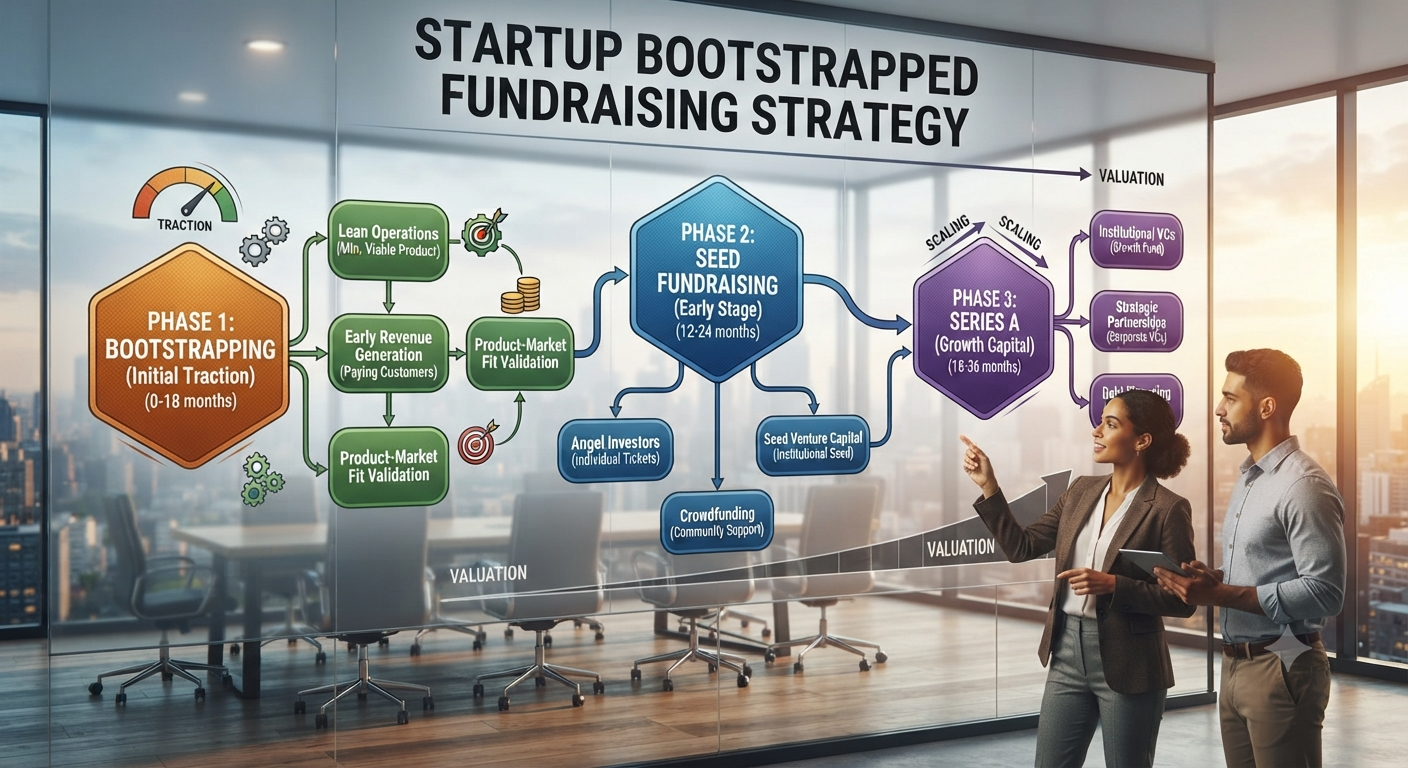
A startup booted fundraising strategy is a revenue-first approach in which founders build proof with savings, customer payments, and disciplined spending before taking selective outside capital. The objective is not to avoid investors forever. It is to raise only when money can accelerate a working business, rather than rescue an unproven one.
The phrase is not a formal legal funding category. In practical use, a startup booted fundraising strategy is best understood as a hybrid between pure bootstrapping and conventional venture fundraising: preserve control early, create measurable traction, then choose the least expensive capital capable of reaching the next valuable milestone.
What Is a Startup Booted Fundraising Strategy?
A startup booted fundraising strategy starts with internal resources—founder savings, operating revenue, preorders, consulting income, or customer-funded development. External financing enters later and deliberately, after the company has reduced product, market, or execution risk.
That distinction matters. The startup booted fundraising strategy reverses the usual order: traditional fundraising often begins with a target round size and an investor story. A booted approach begins with a customer problem, a cash plan, and a specific proof point the business must reach.
The U.S. Small Business Administration describes self-funding, or bootstrapping, as using personal financial resources to support a business. Stripe similarly notes that bootstrapped companies rely on founder capital or business revenue, preserving control but sometimes limiting growth speed.
Bootstrapping Is the Base, Not the Entire Plan
Pure bootstrapping means growing without external equity. A startup booted fundraising strategy is broader: it allows grants, customer advances, debt, revenue-based finance, crowdfunding, angel capital, SAFEs, or a priced equity round when the economics justify them.
The core rule is simple: capital must buy a measurable increase in enterprise value. If a proposed investment cannot clearly improve revenue, retention, margins, distribution, defensibility, or speed to a critical milestone, it is probably premature.
Why This Model Gives Founders More Leverage
Fundraising power comes from alternatives. A founder who must close a round within six weeks negotiates from fear; a founder with revenue, low burn, and 12 months of runway can reject weak terms.
This is where a startup booted fundraising strategy changes the conversation. Investors are no longer being asked to fund an idea alone. They are being offered entry into a business that has already converted limited resources into customer evidence.
The ownership impact is substantial. Carta reported that the median founding team retained 56.2% after seed, 36.1% at Series A, and 23% at Series B in its 2025 ownership analysis. Carta also reported median dilution of 18.8% at seed and 17.9% at Series A in Q1 2025, showing why the timing and size of each round deserve careful planning.
A startup booted fundraising strategy creates other advantages:
- Cleaner priorities: Paying customers expose weak value propositions quickly.
- Stronger unit economics: Scarcity forces attention toward gross margin, payback period, and cash conversion.
- More strategic freedom: Founders can optimize for durable value rather than an investor’s fund timeline.
- A simpler cap table: Fewer early instruments reduce administrative and negotiation complexity.
- Better investor selection: The company can choose partners for expertise and access, not just survival cash.
The trade-off is real. Limited cash can slow hiring, product development, inventory purchases, regulatory work, or market entry.
The correct goal is therefore not “never raise.” It is never raise without knowing exactly what the money is meant to unlock.
The Startup Booted Fundraising Strategy Readiness Test
Before contacting investors, score the business across five areas. A strong startup booted fundraising strategy turns fundraising readiness into evidence, not optimism.
1. Customer Proof
Can the company show paid pilots, repeat purchases, subscriptions, signed contracts, preorders, or strong usage from a tightly defined customer segment?
Techstars advises founders to prove that customers use the product, revenue exists, the model can repeat, and customers stay because they receive value.
A few paying customers can be more persuasive than thousands of free users. Paid demand demonstrates that the problem is important enough for someone to allocate a budget toward solving it.
2. Economic Proof
Track the metrics that explain whether growth creates or destroys cash:
- Gross margin
- Customer acquisition cost
- Contribution margin
- Payback period
- Churn or repeat-purchase rate
- Average contract value
- Net revenue retention, where relevant
- Cash conversion cycle
Early metrics will be imperfect. What matters is that the team understands the drivers, explains the limitations, and shows how capital will improve them.
A company with weak margins but a credible plan to improve them may still be attractive. A company that cannot explain its margins will struggle to earn investor confidence.
3. Operational Proof
Document how the business delivers its product, supports customers, handles quality, manages suppliers, and reports finances. Investors should see that growth will not instantly break the company.
Real-time visibility into cash, burn, and runway is a basic requirement for disciplined financial management and investor readiness.
Operational proof may include documented workflows, supplier agreements, customer-support response times, software uptime, production capacity, or delivery performance. The relevant evidence depends on the business model.
4. Market Proof
Define the initial market from the bottom up. Instead of claiming a giant global total addressable market, show the number of reachable buyers, realistic annual spend, current conversion rate, and channels that can acquire them.
A focused market can be more credible than an enormous but abstract opportunity. Investors want to understand how the company will reach its first 100, 1,000, or 10,000 profitable customers.
5. Milestone Proof
Name the next milestone in one sentence.
Examples include:
- Reaching $1 million in annual recurring revenue
- Obtaining regulatory approval
- Opening a second profitable location
- Reducing acquisition payback below six months
- Completing a production run backed by confirmed demand
- Increasing gross margin from 35% to 55%
- Converting five paid pilots into annual contracts
If the milestone is vague, the raise will be vague too.
Build the Strategy Around a Milestone, Not a Round
The strongest startup booted fundraising strategy asks, “What proof will make this company materially more valuable?” It does not start with, “How much can we raise?”
Use this sequence:
- Choose the next value inflection point.
- Estimate the time required to reach it.
- Model the monthly cash needed.
- Subtract available cash and conservative operating inflows.
- Add a contingency buffer.
- Raise only the remaining capital gap.
A practical formula is:
Capital required = milestone costs + operating burn + contingency reserve − available cash − conservative cash inflows
Suppose a software startup needs $420,000 to build integrations, hire two salespeople, and operate for 15 months. It has $140,000 in cash and expects $130,000 in conservative gross profit during that period.
After adding a $60,000 reserve, its capital gap is $210,000—not the $1 million round the founders initially imagined.
Raising the smaller amount may reduce dilution, shorten the fundraising process, and create a stronger basis for a later round. It also prevents the company from increasing expenses simply because excess cash is available.
How a Startup Booted Fundraising Strategy Uses a Capital Ladder
A startup booted fundraising strategy should rank capital sources from least dilutive to most dilutive. Founders must also consider risk, repayment pressure, speed, flexibility, legal cost, and operational complexity.
The cheapest-looking capital is not always the cheapest capital. A loan with aggressive repayment terms can be more damaging than equity, while an unnecessarily large equity round can permanently surrender valuable ownership.
Customer-Funded Growth
Customer cash is often the highest-quality funding because it validates demand and does not dilute ownership.
Possible models include:
- Annual prepayment discounts
- Paid discovery projects
- Implementation fees
- Customer deposits
- Membership programs
- Product preorders
- Minimum purchase commitments
- Paid pilots
- Co-development agreements
Do not disguise financing as a bad customer deal. Delivery obligations must remain achievable, and refund terms, revenue recognition, working-capital needs, and service costs must be modeled carefully.
A large upfront customer payment creates cash, but it may also create months of delivery obligations. Treat the payment as committed operating responsibility—not free money.
Grants, Competitions, and Strategic Programs
Non-dilutive grants can fund research, commercialization, export activity, workforce development, or sector-specific innovation. They are especially valuable when technical development occurs before dependable revenue.
Startup competitions, university programs, corporate innovation funds, government initiatives, and accelerator programs may also provide non-dilutive funding, infrastructure, mentorship, or market access.
The downside is timing. Applications can be slow, restricted, and reporting-heavy, so grant income should not be treated as guaranteed runway until an award is confirmed.
Supplier Credit and Working-Capital Tools
For inventory or equipment-heavy companies, negotiated payment terms can reduce the amount of cash tied up before a sale.
Useful tools may include:
- Supplier credit
- Purchase-order financing
- Invoice financing
- Equipment leasing
- Equipment finance
- Revolving credit
- Inventory financing
Debt is not automatically cheaper than equity. Fees, covenants, collateral, personal guarantees, and repayment timing can make it dangerous when cash flow is volatile.
The financing term should match the asset or cash-flow cycle. Long-term assets should not normally be financed with obligations that become due before those assets can generate returns.
Revenue-Based Financing
Revenue-based financing exchanges a percentage of future revenue for upfront capital. It can suit businesses with predictable recurring revenue and healthy margins, but repayments rise when revenue rises and can constrain reinvestment.
Compare the total repayment cap and effective cost against the equity value you would otherwise surrender. Cheap-looking non-dilutive money can become expensive if it drains cash during a crucial growth window.
This model is generally less suitable for pre-revenue companies, highly seasonal businesses, thin-margin operations, or companies with unpredictable cash collection.
Crowdfunding
Reward crowdfunding can validate demand and finance production. It also gives founders an opportunity to build a customer community before the full product launch.
Equity crowdfunding can mobilize customers and community investors, but it introduces securities compliance, disclosure, campaign, investor-relations, and cap-table considerations.
In the United States, Regulation Crowdfunding permits eligible companies to raise up to $5 million in a 12-month period through an SEC-registered intermediary. Founders should obtain jurisdiction-specific legal advice before offering securities.
Angel or Venture Equity
Equity becomes attractive when speed matters more than ownership preservation.
Examples include situations where:
- The market is winner-take-most.
- Technical development is capital-intensive.
- Regulatory approval requires substantial investment.
- Manufacturing needs large minimum orders.
- Network effects reward rapid adoption.
- Distribution must be secured quickly.
- International expansion has a narrow timing window.
The test is not whether equity is “good” or “bad.” It is whether the expected value created by the capital exceeds the economic and governance cost of dilution.
Select the Right Fundraising Instrument
The financing instrument must fit the maturity of the company and the certainty of its valuation. A startup booted fundraising strategy should not default to a SAFE merely because it appears simple.
Y Combinator publishes post-money SAFE forms with valuation-cap, discount, and most-favored-nation structures. Its documentation emphasizes that non-U.S. companies should use appropriate local forms and consult a licensed lawyer.
Key choices include:
- SAFE: Fast and common at early stages, but multiple SAFEs can create unexpected dilution at conversion.
- Convertible note: Adds debt features such as interest and maturity, which may create pressure if a priced round is delayed.
- Priced equity round: Establishes valuation and investor rights clearly, but usually costs more and takes longer.
- Loan or credit facility: Preserves equity but creates repayment obligations and possible security requirements.
- Revenue-share agreement: Aligns repayment with sales but can weaken cash flow during expansion.
Model every instrument on a fully diluted basis. Include founders, employees, option-pool expansion, outstanding SAFEs, convertible notes, warrants, and pro rata rights.
Simple Dilution Example
Suppose an investor provides $500,000 at a $4.5 million pre-money valuation.
The post-money valuation becomes $5 million:
$4.5 million + $500,000 = $5 million
The new investor would own approximately:
$500,000 ÷ $5 million = 10%
That figure may increase indirectly if the financing requires an option-pool expansion before the investment. Founders should model both pre-money and post-money ownership before accepting a term sheet.
Create an Investor Story Built on Capital Efficiency
A compelling startup booted fundraising strategy pitch does not celebrate frugality for its own sake. It explains how the team converted each dollar, month, and customer interaction into reduced risk.
The narrative should answer six questions:
- What painful problem exists?
- Who experiences it most urgently?
- What proof shows customers will pay?
- Why is the solution difficult to copy?
- What repeatable growth engine has emerged?
- What specific milestone will new capital unlock?
Replace vanity metrics with decision-grade evidence. “Ten thousand signups” is weak without activation and retention.
“Forty paid accounts, 92% six-month logo retention, and a four-month acquisition payback” tells investors how the business behaves.
Show Why Capital Changes the Growth Curve
Investors need to see a credible relationship between investment and outcomes.
Avoid statements such as:
We need money for marketing, hiring, and product development.
Use a measurable explanation instead:
The company will use 40% of the round to expand its proven outbound sales channel, 35% to complete two integrations requested by 60% of qualified prospects, and 25% to fund 18 months of core operations.
The second version gives investors something they can evaluate.
Prepare a Lean but Complete Data Room
A startup booted fundraising strategy loses credibility when financial records are incomplete. Before outreach begins, the startup booted fundraising strategy needs a secure data room containing:
- Pitch deck and one-page summary
- Incorporation and governance documents
- Current capitalization table
- Historical financial statements
- Monthly cash-flow forecast
- Revenue by customer or cohort
- Contracts and material commitments
- Product roadmap
- Intellectual-property documentation
- Team agreements and option records
- Key performance indicators
- Fundraising use-of-funds model
- Customer pipeline data
- Major supplier agreements
- Existing debt and financing documents
A cap table is the official record of who owns what, including shareholders, share counts, and equity types. Keeping it accurate is essential before issuing new securities.
Do not wait for an investor to identify inconsistent numbers. Reconcile the deck, financial model, bank balance, revenue reports, and cap table before launching outreach.
Run Fundraising as a Concentrated Process
A startup booted fundraising strategy can still consume the founder’s attention for months. Protect the business by running a focused campaign with a defined investor list, consistent materials, weekly targets, and a clear decision date.
Build the list using:
- Investment thesis
- Funding stage
- Geography
- Typical check size
- Sector experience
- Portfolio conflicts
- Operating expertise
- Founder references
- Follow-on capacity
- Decision speed
Prioritize investors who can improve the company after the wire transfer. Valuable support may include customer access, executive recruitment, regulatory guidance, partnerships, technical expertise, or future financing.
Create momentum ethically. Schedule meetings in a compact window, share the same core metrics, answer diligence quickly, and communicate real progress.
Never invent competing offers, artificial customer traction, or false deadlines. Fundraising relationships often last longer than the original product strategy.
Protect Control Beyond the Valuation
The cheapest valuation is not always the best deal. A startup booted fundraising strategy must evaluate governance as carefully as price.
Review:
- Board composition
- Voting thresholds
- Protective provisions
- Liquidation preferences
- Participation rights
- Anti-dilution clauses
- Information rights
- Founder vesting
- Option-pool treatment
- Pro rata rights
- Redemption terms
- Restrictions on future financing
- Founder removal provisions
- Approval rights over budgets or hiring
Two term sheets with the same valuation can produce very different outcomes.
For example, a high valuation paired with aggressive liquidation preferences may be less founder-friendly than a slightly lower valuation with simple, standard terms. Experienced startup counsel should review the documents, while founders should personally understand every economic and control provision.
A 90-Day Startup Booted Fundraising Strategy Plan
Days 1–30: Strengthen the Business
Choose one priority customer segment, improve pricing, collect overdue receivables, cut low-return spending, and create a weekly cash dashboard.
Interview customers to identify the proof investors will find most credible. Ask why they purchased, what nearly stopped the purchase, what alternatives they considered, and which outcome matters most.
Use those insights to strengthen positioning, retention, pricing, and the fundraising narrative.
Days 31–60: Build the Financing Case
Complete the milestone budget, downside scenario, capitalization model, pitch deck, financial forecast, and data room.
Decide which capital source and instrument fit the need. Model what happens if revenue is 25% below forecast, the round takes three months longer than expected, or the next financing is delayed.
Create a target investor list based on fit—not popularity.
Days 61–90: Create and Close the Process
Approach a tightly matched investor list, track every conversation, send concise follow-ups, and update prospects with material progress.
Compare the full economics of each term sheet. Conduct reference calls with founders who have worked with the investor during both strong and difficult periods.
Close only when the financing structure and partnership support the company’s long-term direction.
Common Mistakes That Weaken the Strategy
A startup booted fundraising strategy fails when founders confuse low spending with good economics. A company can be cheap to operate and still lack demand.
Frequent errors include:
- Raising without a milestone-based use of funds
- Waiting until cash is almost exhausted
- Using personal debt without a downside plan
- Accepting revenue-based finance with unaffordable repayments
- Issuing multiple SAFEs without modeling conversion
- Chasing famous investors who do not fit the business
- Hiding weak retention behind top-line growth
- Ignoring legal, tax, and securities requirements
- Hiring before proving a repeatable growth channel
- Raising more money than the company can deploy effectively
- Treating fundraising as success rather than a financing event
The most dangerous mistake is raising to postpone a hard truth. Capital cannot permanently fix weak demand, poor retention, broken margins, founder conflict, or an unclear market position.
When Bootstrapping Is No Longer the Best Choice
A startup booted fundraising strategy should remain flexible. External capital may be necessary when the company faces large research costs, manufacturing commitments, regulatory approvals, network effects, global expansion pressure, or a narrow competitive window.
Raise when three conditions are present:
- The opportunity is time-sensitive.
- The growth mechanism is supported by evidence.
- The expected return on new capital is meaningfully higher than its cost.
Do not raise merely because competitors announced a round. Their economics, ownership, runway, growth targets, and investor expectations may be completely different.
Fundraising should serve the business model. The business model should not be distorted merely to produce another funding announcement.
Conclusion: Turn Traction Into Negotiating Power
The best startup booted fundraising strategy builds optionality. Start with customers, protect cash, measure unit economics, define the next value milestone, and select the least damaging capital that can reach it.
Your next step is practical: create a 24-month cash model, identify one milestone that would materially improve valuation, and calculate the exact financing gap. Then compare customer funding, grants, debt, revenue-based finance, crowdfunding, and equity on total cost—not headline convenience.
Raise from strength. Every dollar should have a job, every term should be understood, and every investor should improve the probability of building the company you intended to own.
Frequently Asked Questions
What does startup booted fundraising strategy mean?
A startup booted fundraising strategy means financing early progress through founder resources and customer revenue, then adding selective outside capital only when it can accelerate a proven opportunity.
It combines the discipline of bootstrapping with the flexibility of fundraising. The company does not reject investors automatically; it delays or limits dilution until stronger evidence improves its negotiating position.
Can a bootstrapped startup raise venture capital later?
Yes. Bootstrapping does not disqualify a company from venture funding; it may improve its position by demonstrating demand, capital efficiency, and founder execution.
Investors will still assess market size, scalability, team quality, growth rate, retention, defensibility, and the potential for a venture-scale return. A profitable company may be attractive, but profitability alone does not guarantee that its market is large enough for venture capital.
How much money should a bootstrapped startup raise?
Raise enough to reach the next meaningful value milestone plus a realistic contingency reserve.
Calculate the amount from a bottom-up operating plan, subtract current cash and conservative cash inflows, and avoid raising extra money without a credible deployment plan. The right round size should provide enough runway to achieve measurable progress without creating unnecessary dilution or repayment pressure.
Is a SAFE suitable for a startup booted fundraising strategy?
A SAFE can be suitable for an early-stage company that needs a relatively simple instrument before a priced round.
However, founders must model valuation caps, discounts, pro rata rights, option-pool effects, and the combined dilution from all outstanding SAFEs before signing. They should also use documents appropriate for their jurisdiction and obtain qualified legal advice.
What metrics matter most when a bootstrapped startup approaches investors?
The most useful metrics show demand, retention, economics, and repeatability.
Depending on the business, these may include recurring revenue, revenue growth, gross margin, churn, repeat purchases, customer acquisition cost, payback period, contribution margin, sales-cycle length, contract value, net revenue retention, customer concentration, and cash runway.
The best metrics are not always the largest numbers. They are the numbers that clearly explain how the company acquires customers, delivers value, retains revenue, and turns additional capital into sustainable growth.
