
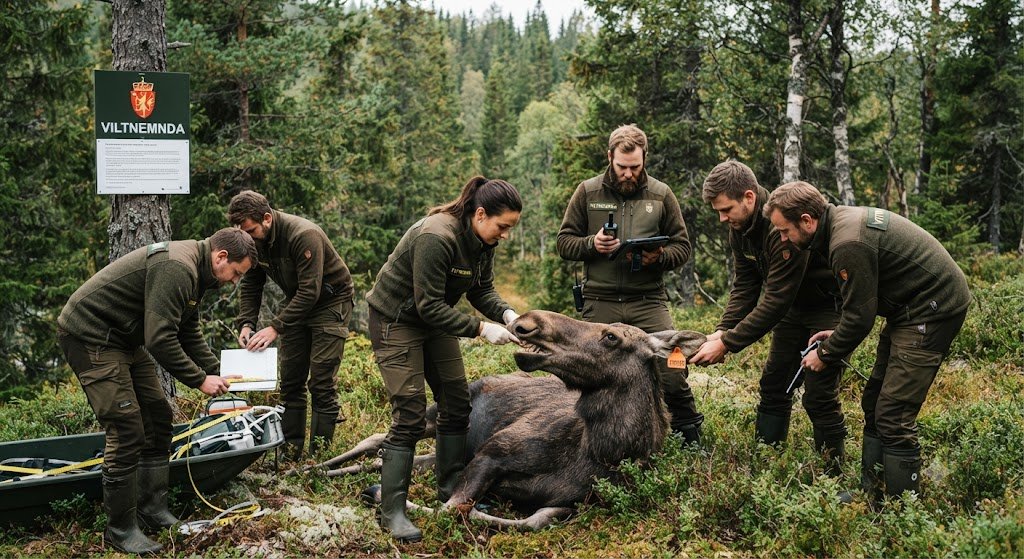
Viltnemnda is a Norwegian term commonly used for a municipal wildlife committee, wildlife authority, or operational team responsible for local wildlife-management tasks. Depending on the municipality, the name may refer to a political committee, an administrative function, a wildlife officer, or a practical response unit that handles injured and dead wild animals.
That distinction matters.
Many people assume Viltnemnda is one standardized national organization with identical powers throughout Norway. It is not. Wildlife-management authority primarily belongs to the municipality, while each municipality decides how its responsibilities are organized and which local name is used.
In some places, residents are still told to contact Viltnemnda. Elsewhere, the same function may be called a fallviltgruppe, ettersøkslag, wildlife unit, municipal game administration, or emergency wildlife team.
This guide explains the history, responsibilities, legal framework, collision procedures, hunting-related duties, and practical limits of the local wildlife authority.
What Does Viltnemnda Mean?
The Norwegian word combines vilt, meaning wild animals or game, with nemnd, meaning a committee or appointed board. A direct English translation would therefore be “wildlife committee” or “game management board.”
Historically, the term had a more precise legal and institutional meaning. From 1952 until the early 1990s, municipal wildlife committees formed a recognized part of Norway’s wildlife-management structure. Legal changes adopted in 1992 replaced the statutory committee model by listing the municipality itself as the local wildlife-management body.
The old formal system disappeared, but the name survived.
Some municipalities retained a committee called Viltnemnda. Others transferred the work to municipal employees, agricultural departments, intermunicipal partnerships, contracted hunters, or dedicated fallvilt teams.
As a result, the term now describes a local organizational solution, not a single nationwide agency.
Is Viltnemnda Still an Official Authority?
It can be, but not automatically.
A municipality may delegate wildlife-related responsibilities to a committee carrying that name. For example, Målselv Municipality describes its Viltnemnda as a local political body responsible for wildlife management, hunting matters, and culling assignments.
In another municipality, however, the same decisions may be handled by:
- A municipal environment or agriculture department
- A wildlife-management officer
- A political committee with a broader portfolio
- A contracted fallvilt response team
- An intermunicipal wildlife service
- The municipal administration itself
The legally important question is not whether an office uses the traditional title. It is which municipal body has been delegated the relevant authority.
Why Viltnemnda Matters in Norwegian Wildlife Management
Norway’s wildlife-management system combines national legislation with regional guidance and local implementation. National authorities establish the legal framework, hunting rules, species protections, and broader management goals, while municipalities perform many practical and administrative duties.
Municipal involvement is essential because wildlife issues are intensely local. Moose populations, deer damage, traffic collisions, migration routes, agricultural losses, hunting pressure, and habitat conditions vary considerably between regions.
A local authority can therefore assess factors that a centralized agency may not see clearly, including:
- Recurring wildlife-crossing locations
- Local population density and condition
- Agricultural and forestry damage
- Hunting-ground boundaries
- Urban wildlife conflicts
- Road and railway risks
- Access to qualified tracking teams
- Cooperation between landowners and hunters
Norwegian authorities describe municipalities as responsible for much of the country’s practical wildlife management. Regional bodies provide guidance, while the State Administrator generally handles appeals against many municipal decisions.
The Current Legal Framework
A major legal update took effect on July 1, 2026.
Norway’s new Wildlife Resources Act, known as viltressursloven, replaced the Wildlife Act of 1981. The new legislation largely continues established rules while restructuring the framework and addressing modern challenges, including technological hunting equipment and clearer responsibilities for wildlife handling.
The law is built around the principle that hunting, trapping, culling, and other handling of wildlife must be conducted sustainably and responsibly. It operates alongside the Nature Diversity Act, the Animal Welfare Act, regulations governing hunting and trapping, and local wildlife-management rules.
For the public, the practical takeaway is straightforward:
The municipality remains the central local wildlife body, regardless of whether it calls the responsible unit Viltnemnda.
From Viltloven to Viltressursloven
Under the previous Wildlife Act, municipalities already handled significant responsibilities involving moose, red deer, roe deer, beaver, hunting areas, permits, fees, and injured wildlife.
The new law clarifies and reorganizes several of these duties. One particularly relevant development concerns public searches for injured wildlife.
From July 2026, municipal responsibility was expanded and clarified to include arrangements for searching for injured wildlife beyond the traditional focus on cervids. Municipalities may carry out this work themselves, cooperate with neighboring authorities, or use contracted personnel commonly known as fallviltjegere.
This does not mean members of the public should call an individual hunter directly. Reports should normally enter through the official notification system, especially when a road collision has occurred.
What Does Viltnemnda Do?
The exact responsibilities vary by municipality, local delegation, species, and incident type. However, the work generally falls into several recognizable categories.
1. Responding to Injured Wildlife
One of the best-known functions is responding to wild animals that have been struck by vehicles, wounded, trapped, or found seriously ill.
The local response team may:
- Inspect the reported location
- Assess tracks, blood, hair, and movement
- Use a trained tracking dog
- Search for an animal that left the road
- Humanely dispatch a severely injured animal
- Remove or coordinate removal of a carcass
- Record the incident in the appropriate register
- Collect samples where disease surveillance requires it
Animal welfare is the central concern. Norwegian guidance states that everyone has a duty to assist sick or injured animals, although the appropriate form of assistance depends on the circumstances and personal safety.
Trying to capture, chase, transport, or treat a large wild animal without professional direction can make the situation worse. It may also place people, dogs, traffic, and the animal at greater risk.
2. Conducting Public Tracking Operations
A collision does not always kill an animal immediately. A moose or deer may run into woodland despite suffering severe internal injuries or broken bones.
The response personnel therefore look beyond the visible scene.
They may investigate:
- The vehicle’s point of impact
- The animal’s direction of travel
- Hoof marks and disturbed vegetation
- Blood, tissue, bone, or hair
- Bedding locations
- Changes in gait
- Signs that the animal crossed a river or road
- Whether the animal joined other animals
Qualified tracking can continue for hours and sometimes over difficult terrain. The objective is not simply to find a carcass; it is to determine responsibly whether an animal is injured and, when necessary, end its suffering as quickly as circumstances allow.
3. Managing Fallen Wildlife
The term fallvilt broadly refers to wildlife found dead or injured for reasons other than ordinary legal hunting. It can include animals killed by traffic, disease, fences, drowning, starvation, territorial conflict, or other accidents.
Municipal teams may register fallen wildlife and coordinate disposal, sampling, or transfer. The response depends on the species, carcass location, condition, ownership rules, disease concerns, and whether the animal presents a road-safety or public-health issue.
Municipalities also have responsibilities connected with disease reporting. Norway’s 2026–2030 cervid-management strategy notes that municipalities must alert the Norwegian Food Safety Authority when serious animal disease is suspected and must follow reporting procedures for certain fallen cervids.
4. Supporting Sustainable Deer Management
Municipal wildlife management is not limited to emergencies. It also helps regulate populations of moose, red deer, and roe deer.
Depending on delegated powers, the responsible municipal body may work with:
- Hunting-area approval
- Population-management objectives
- Minimum hunting-area requirements
- Harvest permits
- Hunting quotas
- Multi-year management plans
- Harvest reporting
- Population and collision statistics
- Landowner cooperation
- Measures to reduce crop and forest damage
The goal is rarely to maximize the number of animals. Effective management balances ecological sustainability, animal health, hunting interests, traffic safety, forestry, agriculture, and public acceptance.
5. Issuing or Administering Hunting Permissions
The municipality plays an important role in issuing permits for certain huntable species within nationally and locally established frameworks.
Under Norwegian wildlife rules, municipal decisions may address approved hunting units, quotas, population plans, or permissions involving animals causing serious damage. Official guidance notes, for example, that municipalities can authorize landowners to kill cervids that are damaging forest, agricultural land, or fruit trees when legal conditions are satisfied.
A farmer or property owner cannot simply assume that economic loss creates an unrestricted right to shoot wildlife. The legal basis, species, urgency, alternatives, safety conditions, and authorizing body must be assessed.
6. Preventing Wildlife Damage and Collisions
Good management is preventive, not merely reactive.
A Viltnemnda or equivalent municipal authority may contribute knowledge for:
- Wildlife-crossing signs
- Roadside vegetation management
- Fencing proposals
- Seasonal driver warnings
- Mapping collision hotspots
- Railroad mitigation
- Public-information campaigns
- Population-control measures
- Habitat and migration assessments
Responsibility is often shared among road authorities, municipalities, county authorities, police, landowners, railway operators, and wildlife specialists.
Recent Norwegian strategy documents link the rise in wildlife collisions to multiple factors, including cervid abundance, landscape fragmentation, traffic volume, and vehicle speed. They emphasize cross-sector cooperation rather than treating every collision as an isolated event.
What to Do After Hitting a Wild Animal
This is the situation in which most residents and visitors encounter the local wildlife service.
The most important rule is simple:
Report the collision to the police.
Norwegian municipal and environmental guidance instructs motorists to call the police at 02800 after hitting wildlife. The police coordinate with the appropriate local team, which may be Viltnemnda, a fallviltgruppe, or contracted tracking personnel.
Step-by-Step Procedure
- Stop safely.
Turn on hazard lights and position the vehicle where it does not create another collision risk. - Secure the scene.
Use a warning triangle and reflective clothing when it is safe to do so. - Do not chase the animal.
A frightened and injured moose, deer, boar, or other animal can be unpredictable. - Call the police on 02800.
Use the emergency number 112 when people are injured, traffic is in immediate danger, or another urgent threat exists. - Describe the exact location.
Provide the road number, direction of travel, nearby landmarks, coordinates, or a map pin. - Mark where the animal left the road.
A visible marker can save valuable time for the tracking team. Do not follow the animal into the terrain. - Report what you observed.
Mention the species, approximate size, direction of escape, visible injuries, and whether blood or hair is present. - Follow police instructions.
The police will determine whether you should remain, move the vehicle, or leave after providing the required information.
Reporting is necessary even when the animal runs away and appears mobile. Adrenaline can allow badly injured animals to travel a considerable distance.
Should You Call Viltnemnda Directly?
Usually, the safest approach after a traffic collision is to call the police first.
A municipality may publish a direct wildlife contact number, but procedures differ. Calling the police ensures that the incident is recorded and forwarded to the officially responsible local personnel.
Direct municipal contact may be appropriate for non-urgent administrative matters such as:
- Questions about hunting areas
- Wildlife-management plans
- Repeated deer damage
- Carcass removal from municipal land
- Local wildlife statistics
- Permit applications
- Municipal wildlife-fund matters
Always check the relevant municipality’s current instructions because names, contractors, and duty numbers can change.
Viltnemnda and Hunters: Who Is Responsible After a Wounding?
A hunter who fires at an animal carries a direct responsibility to determine whether it was hit.
Under the Wildlife Resources Act, a hunter who shoots at wildlife must establish whether the animal has been struck. Wounded wildlife must be killed as quickly as possible using a lawful and humane method.
For big-game hunting, tracking obligations and access to an approved tracking dog are central parts of responsible practice. A hunter cannot treat a missing animal as a clean miss merely because there is no obvious blood at the shot site.
The roles can be separated as follows:
- The hunter or hunting team performs the immediate mandatory search following a shot.
- The municipality becomes involved according to reporting rules, time limits, species, circumstances, and applicable regulations.
- Public tracking personnel handle assignments initiated as official searches rather than ordinary continuation of the hunt.
- The police may become involved when safety, suspected violations, road incidents, or other enforcement matters arise.
Local instructions should be checked before the hunt begins. Waiting until an animal is wounded is the wrong time to discover that the tracking agreement is incomplete or the contact information is outdated.
Viltnemnda, Police, and Other Authorities
Wildlife incidents often cross institutional boundaries. Understanding those boundaries prevents delays and incorrect reporting.
The Municipality
The municipality is the core local wildlife-management authority. It handles administrative duties, population planning, permits, local regulations, public tracking organization, and other tasks assigned by law or delegation.
The Police
The police receive road-collision reports, coordinate immediate response, manage public safety, and investigate potential violations. They are the normal first contact when a motorist hits a wild animal.
The State Administrator
The State Administrator acts as the appeal body for many municipal wildlife decisions and performs regional administrative functions. A person challenging a municipal decision must follow the formal appeal process rather than treating the local response team as the final national authority.
The County Municipality
County authorities may provide advice and coordinate management for various huntable species, though responsibilities differ by species and legal area.
The Norwegian Environment Agency
The Norwegian Environment Agency provides national guidance on wildlife, nature management, injured animals, regulations, and related environmental responsibilities.
The Norwegian Agriculture Agency
The Norwegian Agriculture Agency has responsibilities connected with harvestable wildlife, hunting administration, cervid management, regulations, and guidance for municipalities.
The Norwegian Food Safety Authority
The Food Safety Authority becomes relevant when wildlife disease, infection monitoring, carcass sampling, or animal-health risks are suspected.
Statens Naturoppsyn
The Norwegian Nature Inspectorate performs environmental supervision and may participate in specially authorized wildlife operations. It is not a substitute for the ordinary municipal collision-response system.
Common Misconceptions About Viltnemnda
“It Is a National Emergency Service”
No. The term normally refers to a local municipal arrangement. Norway does not operate one national Viltnemnda dispatch center.
“Every Municipality Has the Same Committee”
No. Municipalities organize their responsibilities differently. The traditional name may remain even where the structure, delegation, and personnel are entirely different.
“Its Members Can Shoot Any Problem Animal”
No. Wildlife may be killed only when a valid legal basis exists. Species protection, authority, method, safety, necessity, animal welfare, and reporting requirements all matter.
“A Driver Should Follow the Injured Animal”
No. Following the animal can destroy useful tracks, push it farther into the terrain, create danger, and make professional tracking harder.
“No Report Is Needed If the Animal Escapes”
Wrong. An animal may run despite serious injuries. Police and tracking personnel need the location and direction of travel to assess the case.
“Viltnemnda Controls All Norwegian Wildlife Policy”
No. It handles local responsibilities delegated to the municipality. National ministries, directorates, regional authorities, police, and other institutions retain separate powers.
How to Find Your Local Viltnemnda
Search the municipality’s official website rather than relying on an old directory, social-media comment, or private phone listing.
Useful search phrases include:
- “[Municipality name] Viltnemnda”
- “[Municipality name] fallvilt”
- “[Municipality name] viltforvaltning”
- “[Municipality name] ettersøkslag”
- “[Municipality name] skadet vilt”
- “[Municipality name] viltpåkjørsel”
Check whether the page is current and whether it distinguishes emergency reporting from administrative enquiries.
For an active road incident, searching online should not delay the report. Contact the police directly.
Why Local Wildlife Committees Face Difficult Decisions
Wildlife management involves competing legitimate interests. A high deer population may provide hunting opportunities while also increasing collisions, browsing damage, disease concerns, and pressure on vegetation.
Reducing a population is not automatically simple either. Authorities must consider uncertain population estimates, landowner cooperation, hunter capacity, migration across municipal boundaries, weather, public opinion, animal welfare, and ecological effects.
A capable Viltnemnda therefore needs more than field experience. Strong local management depends on:
- Reliable population data
- Transparent decision-making
- Knowledge of administrative law
- Skilled tracking personnel
- Documented delegation
- Cooperation with landowners
- Clear public communication
- Cross-municipal planning
- Accurate harvest and collision reporting
- Separation between personal hunting interests and public duties
Public trust grows when decisions are traceable, evidence-based, and clearly connected to legal authority.
Frequently Asked Questions
What is Viltnemnda in Norway?
Viltnemnda is a traditional Norwegian name for a local wildlife committee or municipal wildlife-management function. It may handle hunting administration, injured wildlife, fallen animals, population planning, damage prevention, and related local matters.
The organizational form differs between municipalities. Some retain a formal committee, while others use municipal staff, contracted wildlife personnel, or a fallvilt team.
Who should I call after hitting a deer or moose?
Call the Norwegian police on 02800 and provide the exact location, species, direction of travel, and any visible signs of injury. Call 112 when the collision creates an immediate emergency involving people or traffic.
Do not pursue the animal. Mark the point where it left the road when this can be done safely and follow the instructions you receive.
Can Viltnemnda enter private land to search for injured wildlife?
Official tracking and animal-welfare duties may require authorized personnel to follow an injured animal across property boundaries. The precise legal authority and procedure depend on the incident, applicable legislation, assignment, and species.
Property owners should not obstruct an authorized emergency search. Questions about access, damage, conduct, or authority should be directed to the municipality or police after the immediate animal-welfare situation has been addressed.
Does Viltnemnda remove dead animals?
It may coordinate removal in some cases, but responsibility depends on where the carcass lies, the species, the cause of death, road ownership, public-safety concerns, and local arrangements.
A small dead animal on private property may be treated differently from a moose blocking a national road. Contact the municipality for a non-urgent carcass, or the police when the animal presents a traffic hazard or may have been struck by a vehicle.
Can Viltnemnda give permission to shoot wildlife causing damage?
The municipality can make certain damage-control or culling decisions when legal requirements are met. Permission is not automatic merely because an animal is inconvenient or causing financial loss.
Authorities may consider the species, severity of damage, available preventive measures, safety, timing, conservation status, ownership, and statutory authority before approving any action.
Conclusion: Use the Correct Local Channel
Viltnemnda remains a familiar and useful term, but it should be understood as part of Norway’s municipal wildlife-management system, not as one uniform national institution.
For permits, hunting plans, population management, or recurring wildlife damage, consult the official website of the relevant municipality. For an injured animal or wildlife collision, protect the scene, avoid pursuing the animal, record the location, and report the incident promptly to the police.
Fast reporting is more than an administrative requirement. It gives trained personnel the best possible chance to find the animal, prevent prolonged suffering, protect road users, and produce the accurate data needed for better wildlife management.
